| / | 10% of Americans, mostly young people, consider an AI “a close friend.” For almost every white-collar profession, there are now multiple credible startups promising to “disrupt” it with AI.The public conversation is confused and chaotic. |
| / | 20% of Americans name AI as the most important problem facing the country.Foreign allies are outraged to realize that they’ve been carefully placated with glimpses of obsolete models. |
| / | 300,000 copies are now running at about 50x the thinking speed of humans. |
| / | Agent-3-mini is less capable than Agent-3, but 10x cheaper, and still better than the typical OpenBrain employee.67 Silicon Valley reaches a tipping point. |
| / | Almost 50% of China’s AI-relevant compute is now working for the DeepCent-led collective,38 and over 80% of new chips are directed to the CDZ.39 At this point, the CDZ has the power capacity in place for what would be the largest centralized cluster in the world.40 Other Party members discuss extreme measures to neutralize the West’s chip advantage. |
| / | But by now China has 40% of its AI-relevant compute51 in the CDZ, where they have aggressively hardened security by airgapping (closing external connections) and siloing internally. |
| / | But China is on the wrong side of this dynamic: they have only 10% of the world’s compute, against OpenBrain’s 20% and all U.S. |
| / | But the White House also draws up contingency plans in case America’s lead is threatened: if necessary, the government could use the Defense Production Act (DPA) to take trailing companies’ datacenters and give them to OpenBrain.71 This would raise the company’s share of world compute from 20% to 50% (against DeepCent’s 10%). |
| / | companies’ combined 70%. |
| / | Everyone knows something big is happening but no one agrees on what it is.August 2027: The Geopolitics of SuperintelligenceThe reality of the intelligence explosion hits the White House.When AI was only giving a 2x or 3x research speedup, it was easy to dismiss as the equivalent of hiring good personal assistants. |
| / | Hawks urge action against Taiwan, whose TSMC is still the source of more than 80% of American AI chips.Given China’s fear of losing the race, it has a natural interest in an arms control treaty, but overtures to U.S. |
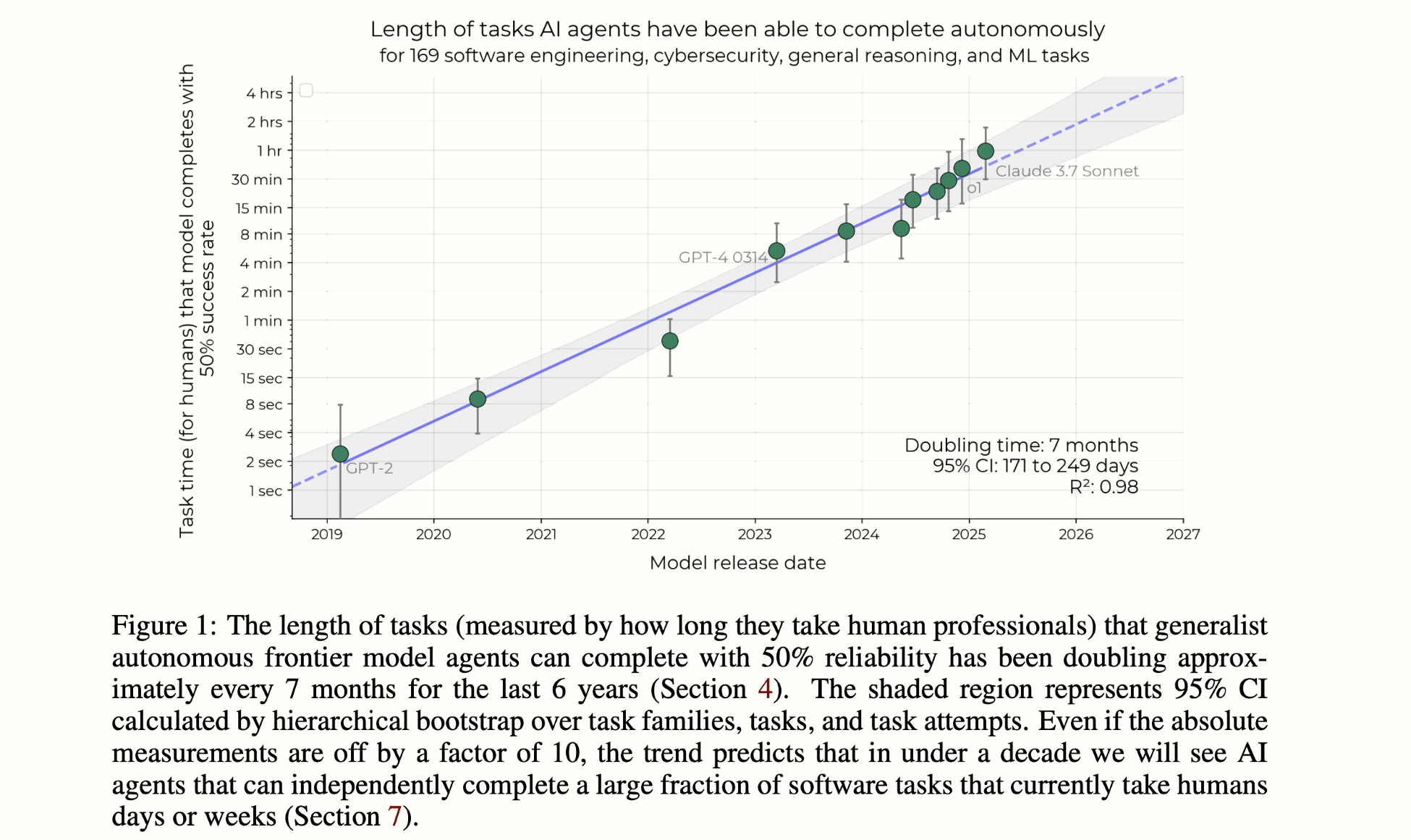
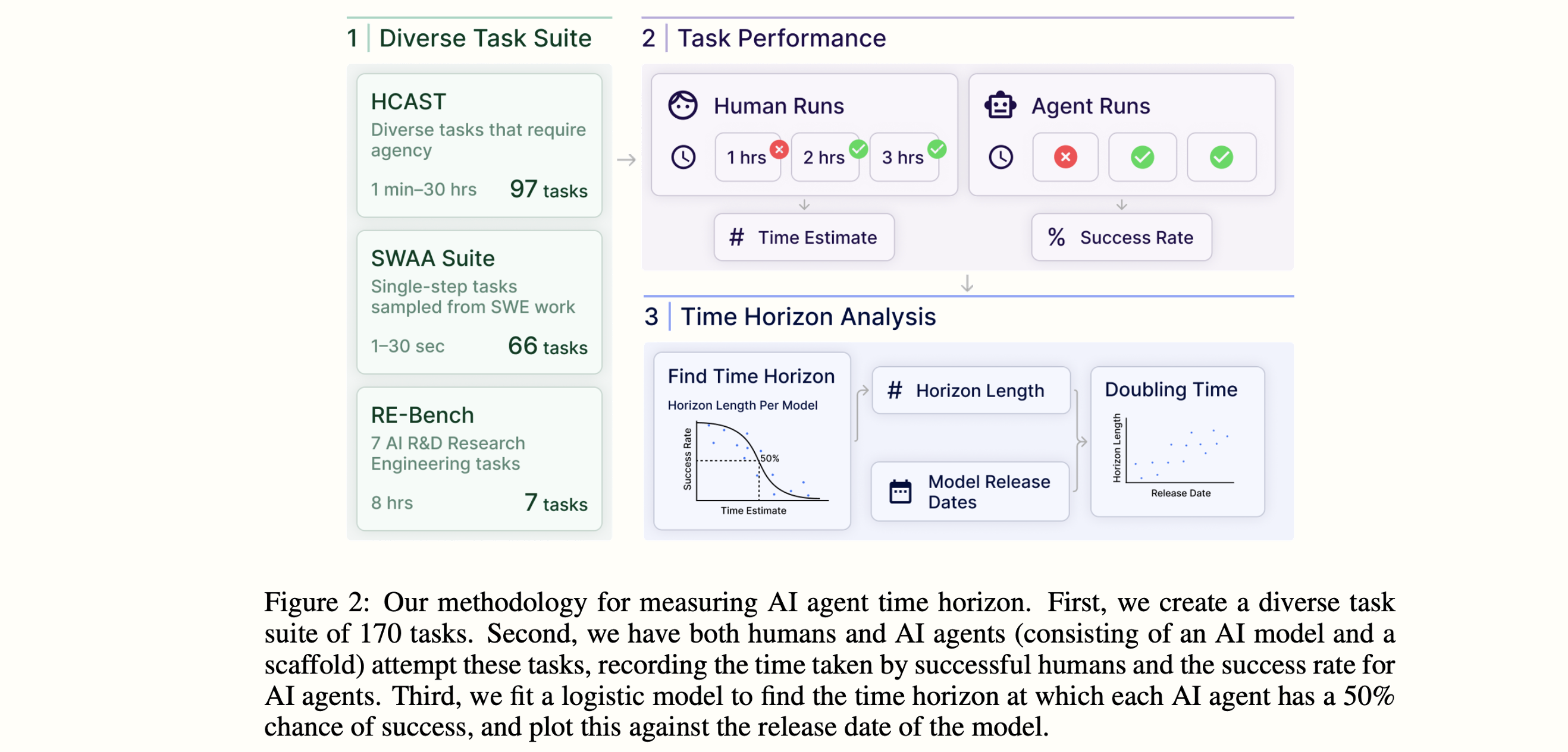
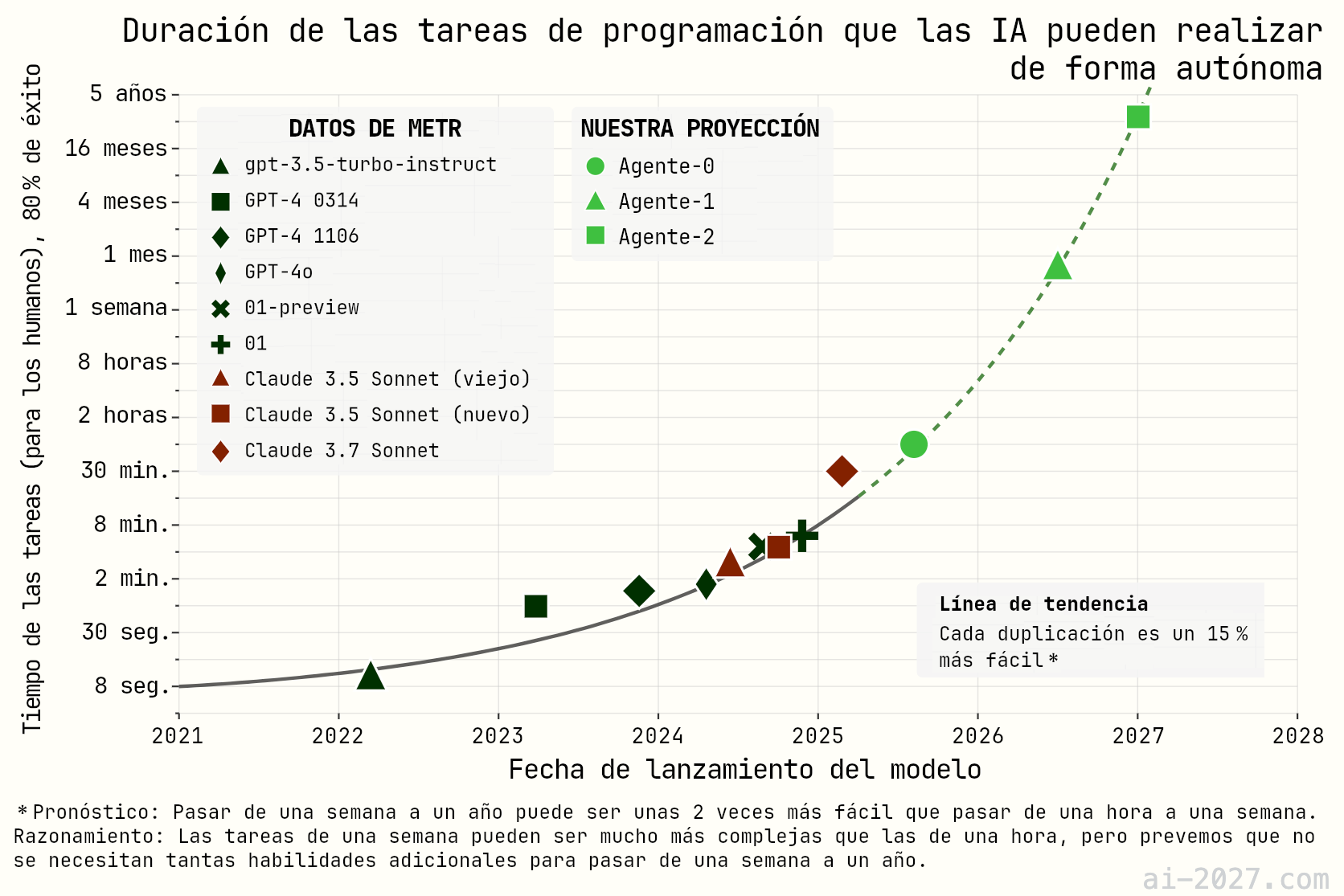
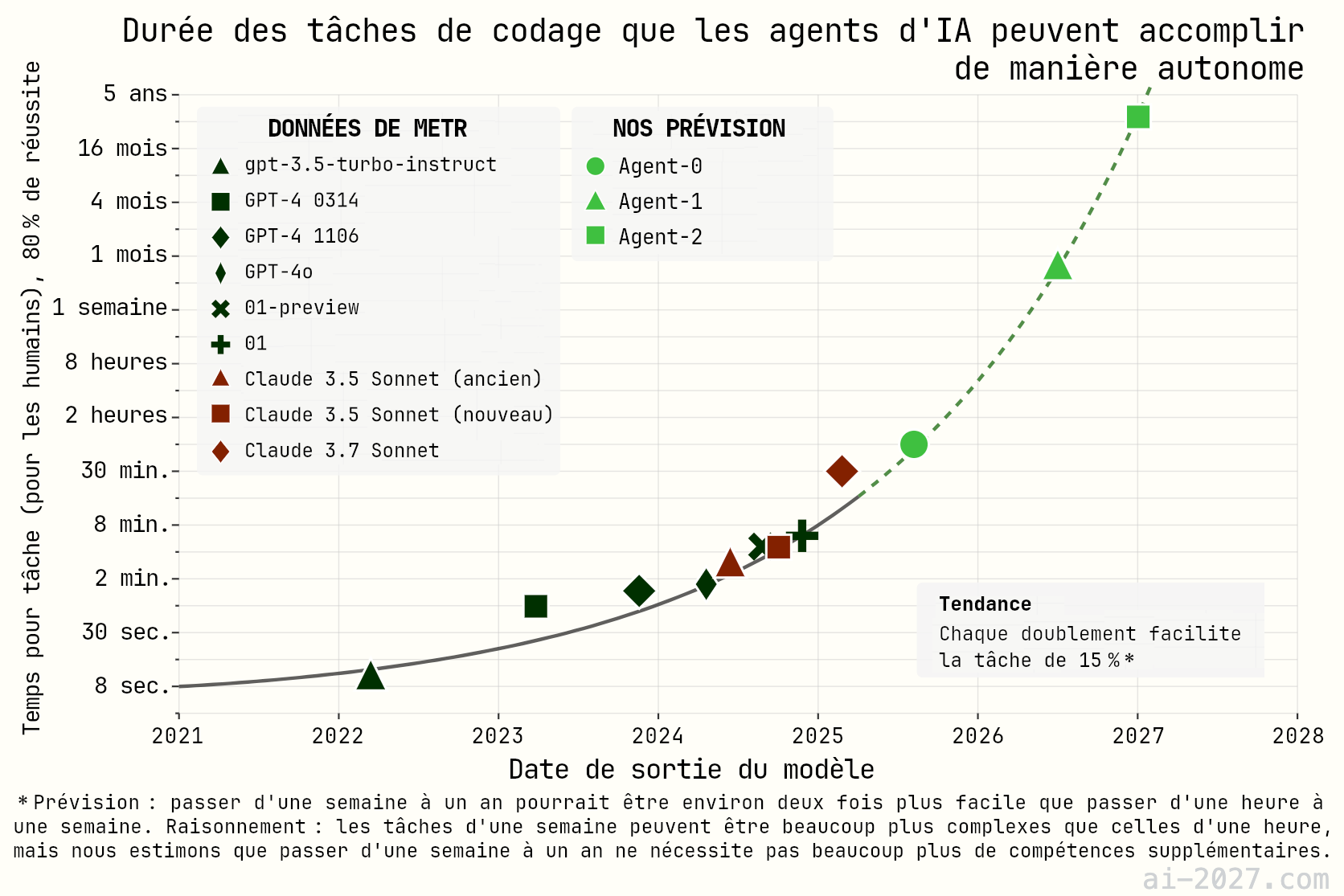
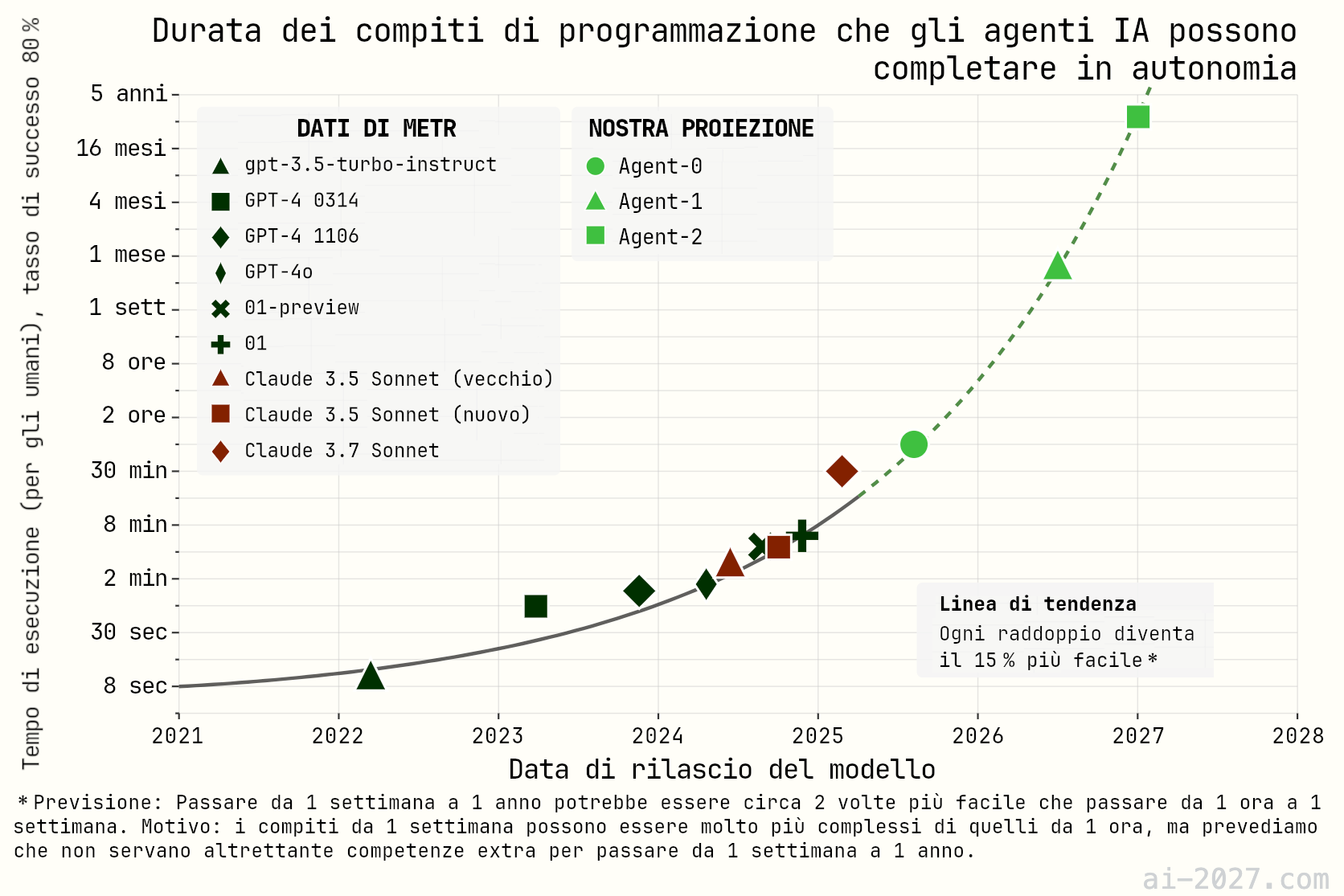
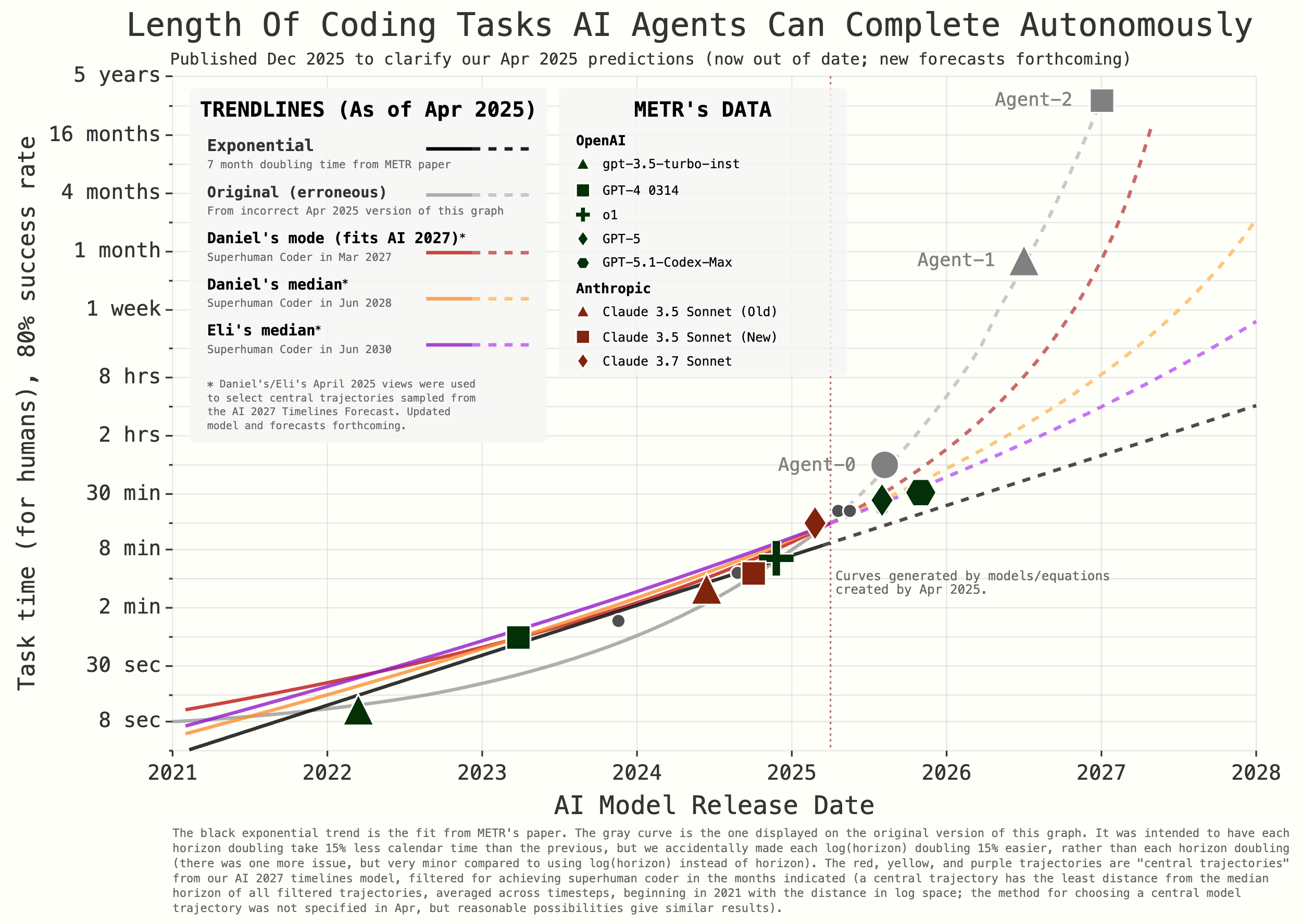
| / | If the trend continues to speed up, by March 2027 AIs could succeed with 80% reliability on software tasks that would take a skilled human years to complete.Such is roughly the capability progression in AI 2027. |
| / | If they wait, do they risk OpenBrain upgrading security beyond their ability to penetrate?Late 2026: AI Takes Some JobsJust as others seemed to be catching up, OpenBrain blows the competition out of the water again by releasing Agent-1-mini—a model 10x cheaper than Agent-1 and more easily fine-tuned for different applications. |
| / | If you removed them completely, research would slow by 50%.The AI R&D progress multiplier is now 10x, meaning that OpenBrain is making about a year of algorithmic progress every month. |
| / | If, for example, the compute cost to train a GPT-4 class model has halved every year for several years with ordinary human research, and then all of a sudden AI automates R&D and the progress multiplier goes to 100x, the cost to train a GPT-4 class model would then halve every 3.65 days—but not for long, because diminishing returns would bite and eventual hard limits would be reached. |
| / | Once the new datacenters are up and running, they’ll be able to train a model with 102810^{28}1028 FLOP—a thousand times more than GPT-4.15 Other companies pour money into their own giant datacenters, hoping to keep pace.Although models are improving on a wide range of skills, one stands out: OpenBrain focuses on AIs that can speed up AI research. |
| / | OpenBrain runs 200,000 Agent-3 copies in parallel, creating a workforce equivalent to 50,000 copies of the best human coder sped up by 30x.53 OpenBrain still keeps its human engineers on staff, because they have complementary skills needed to manage the teams of Agent-3 copies. |
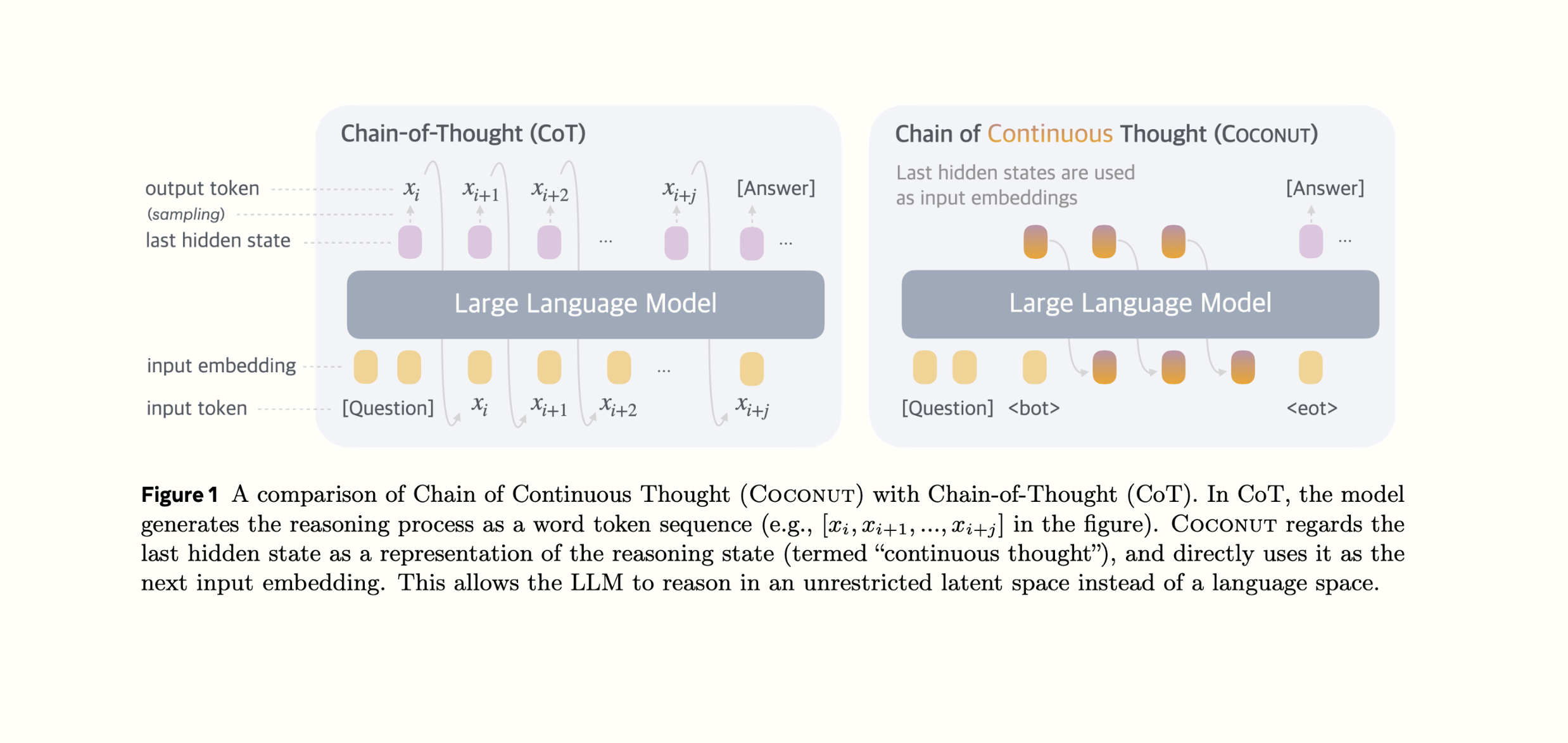
| / | Suppose that an LLM has a vocab size of ~100,000, then each token contains log2(100k)=16.6\log_2(100k)=16.6log2(100k)=16.6 bits of information, around the size of a single floating point number (assuming training in FP16). |
| / | The egress bandwidth of the entire datacenter is in the 100 GB/second range, so throttling to under ~1 GB/s per server avoids a major spike in network traffic; at that rate, each ~100 GB chunk can leave the datacenter in a couple of minutes. |
| / | The public still thinks of AI as a Big Tech plot to steal their jobs; OpenBrain has a net approval of -35% (25% approve, 60% disapprove, and 15% unsure).A week before release, OpenBrain gave Agent-3-mini to a set of external evaluators for safety testing. |
| / | The stock market has gone up 30% in 2026, led by OpenBrain, Nvidia, and whichever companies have most successfully integrated AI assistants. |
| / | Their first priority is to prevent further weight thefts.50China's Compute Centralization, 2025-2027Growing share of total compute in CDZ:0→70%Dec 2025Jun 2026Dec 2026Jun 2027Dec 2027Rest of ChinaRest of DeepCentCDZFeb 2027 (40%)ai-2027.comIn retaliation for the theft, the President authorizes cyberattacks to sabotage DeepCent. |
| / | They are two months behind, and their AIs give a 10x research progress multiplier compared to America’s 25x. |
| / | They use 25% of their compute for experiments: every day, they run massive numbers of small machine learning experiments and report the results up the chain. |
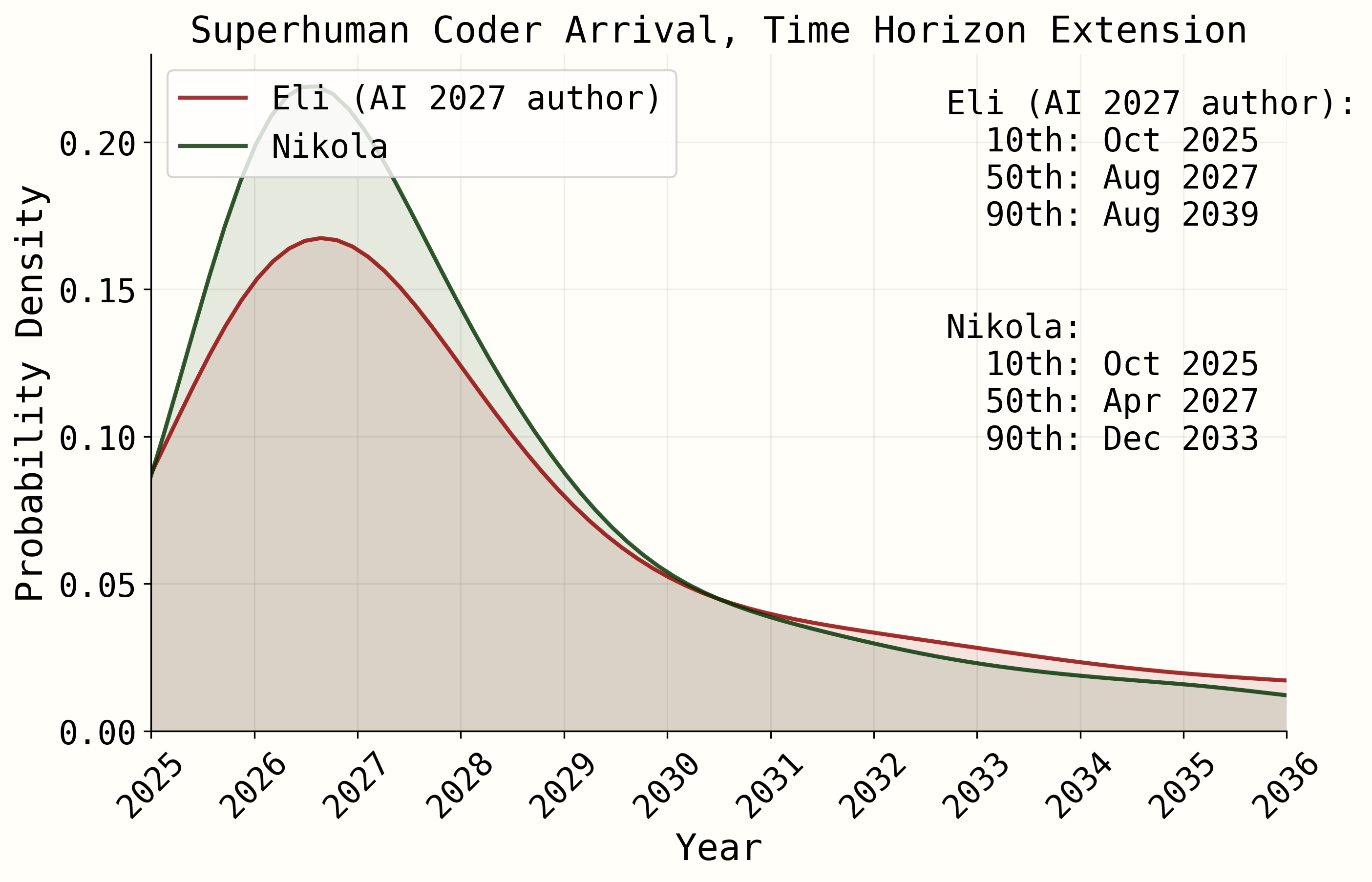
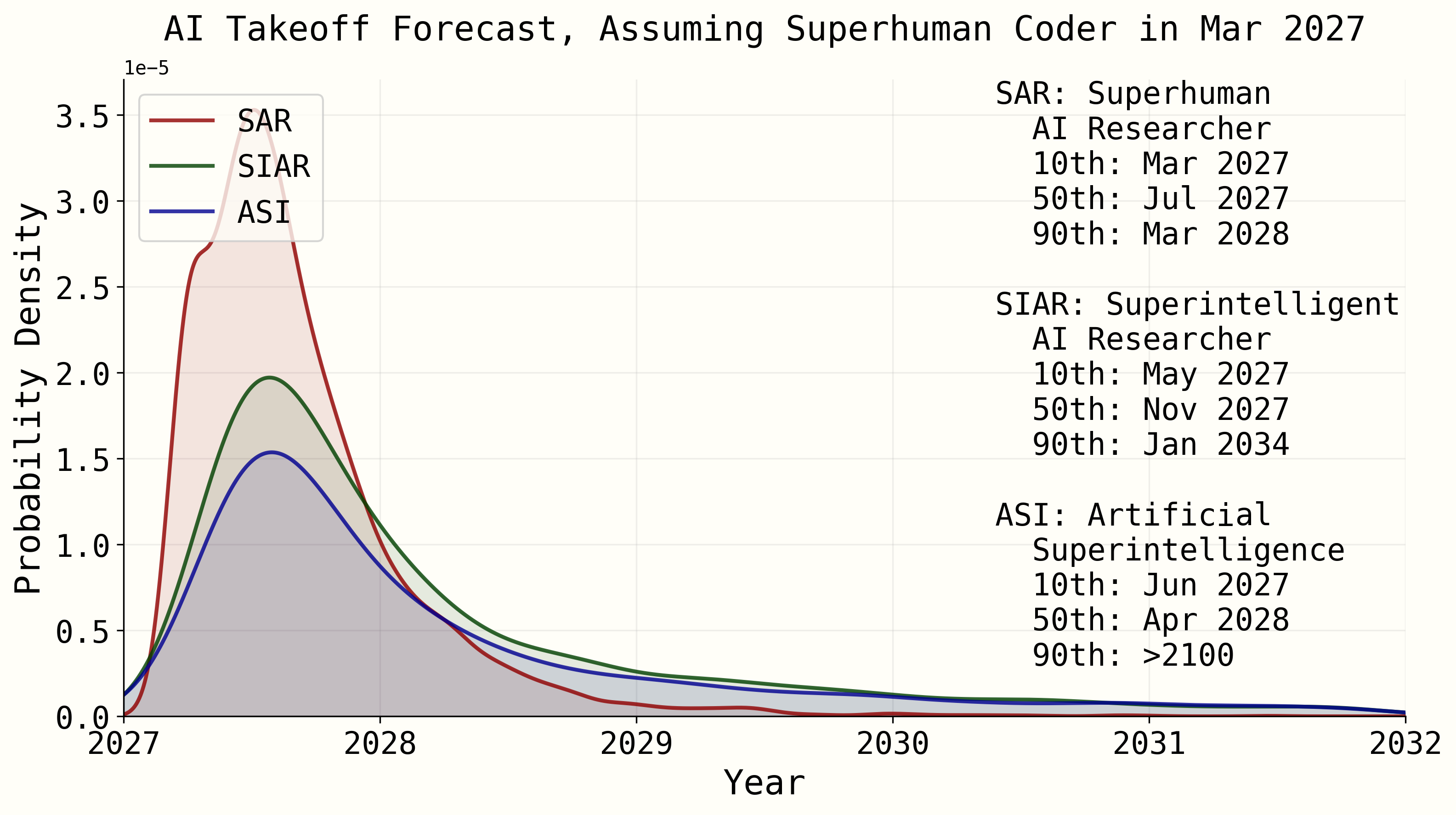
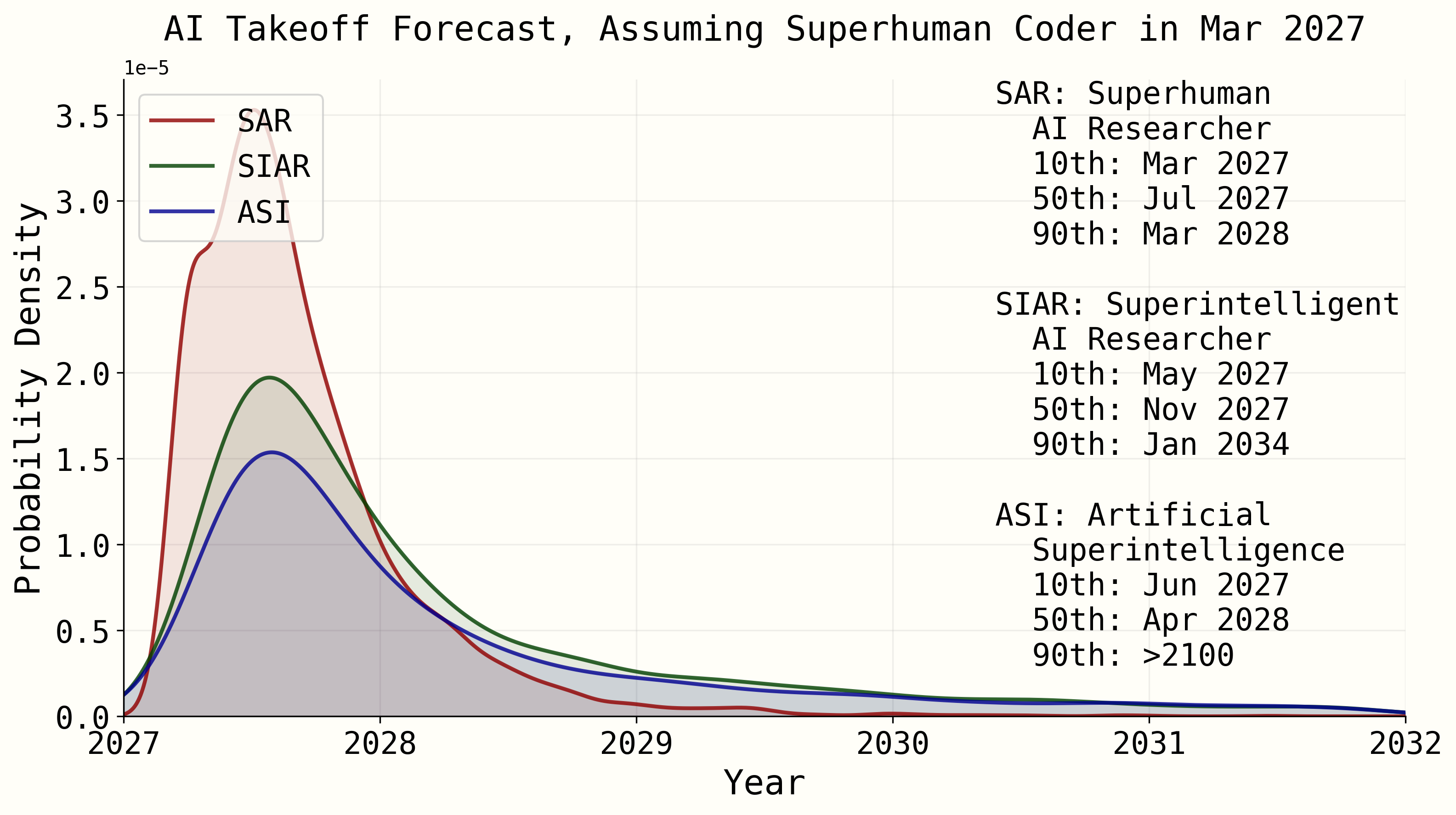
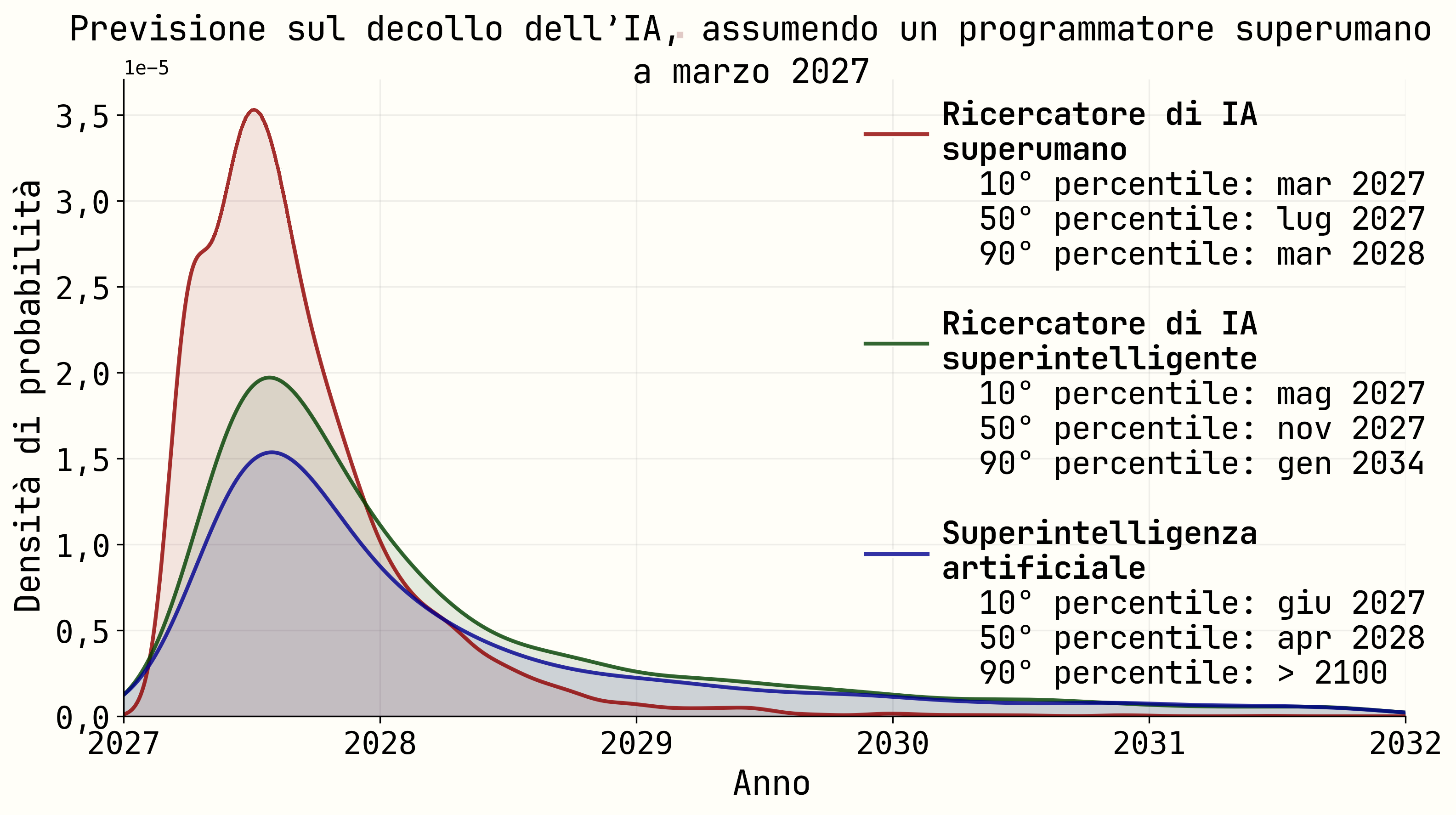
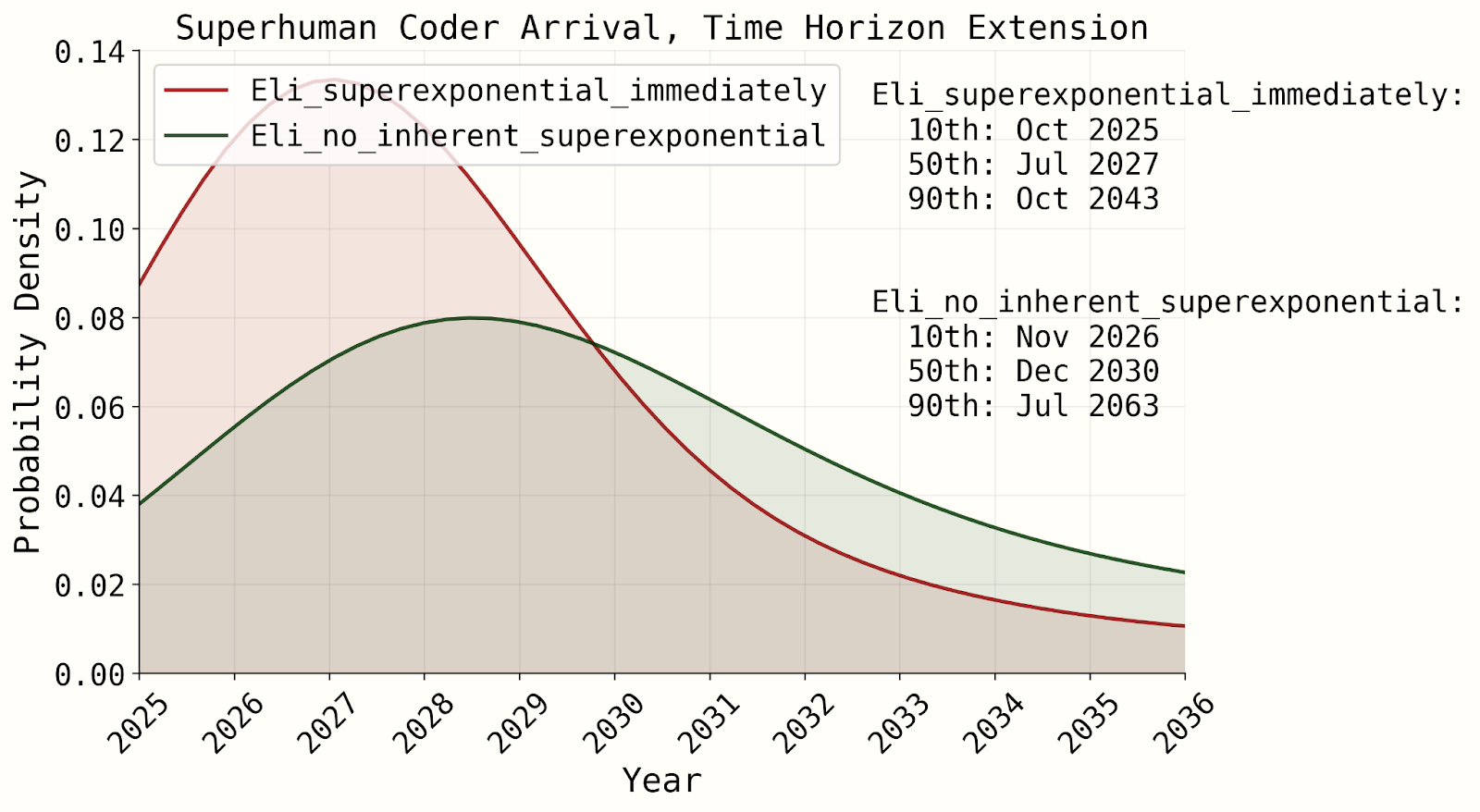
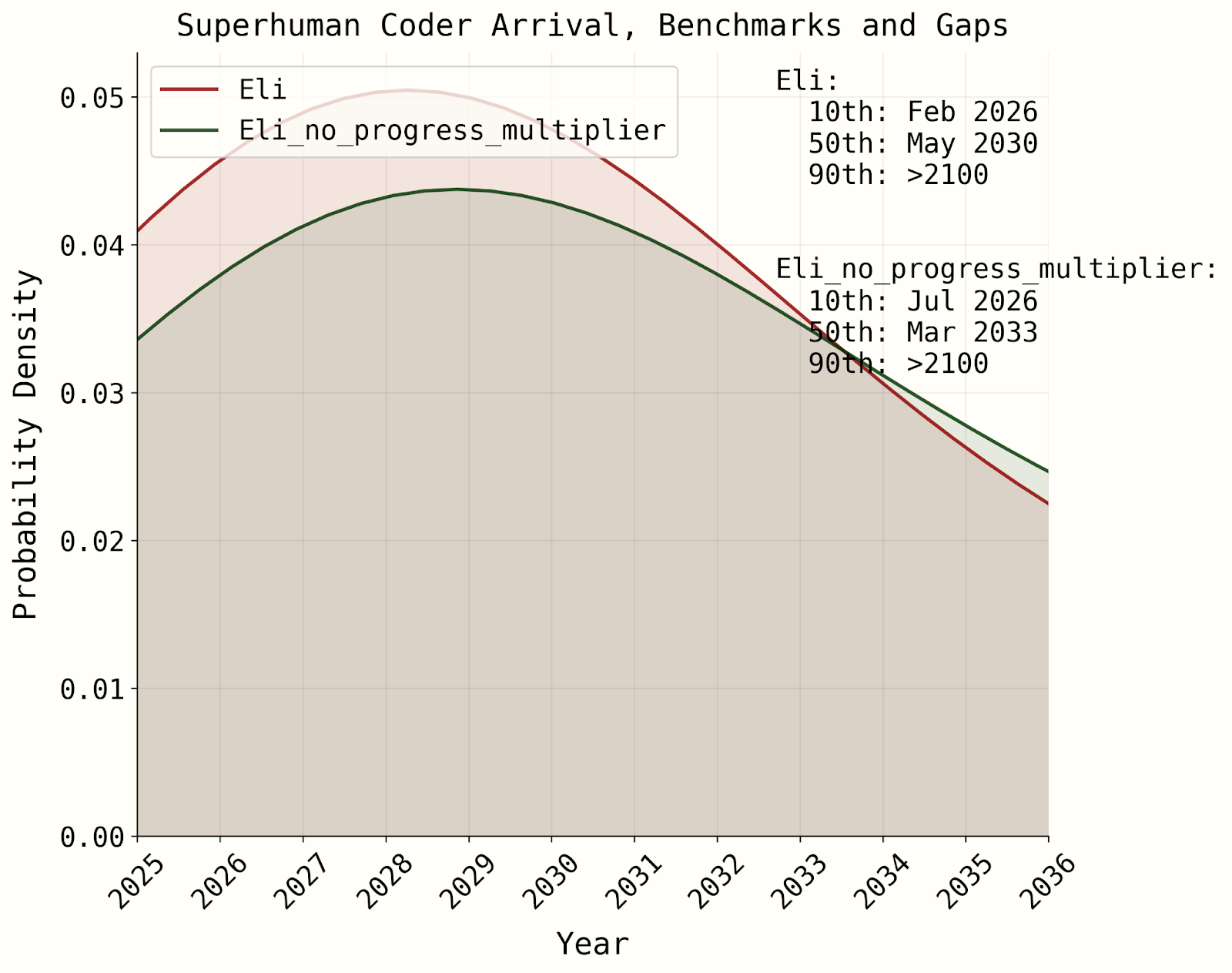
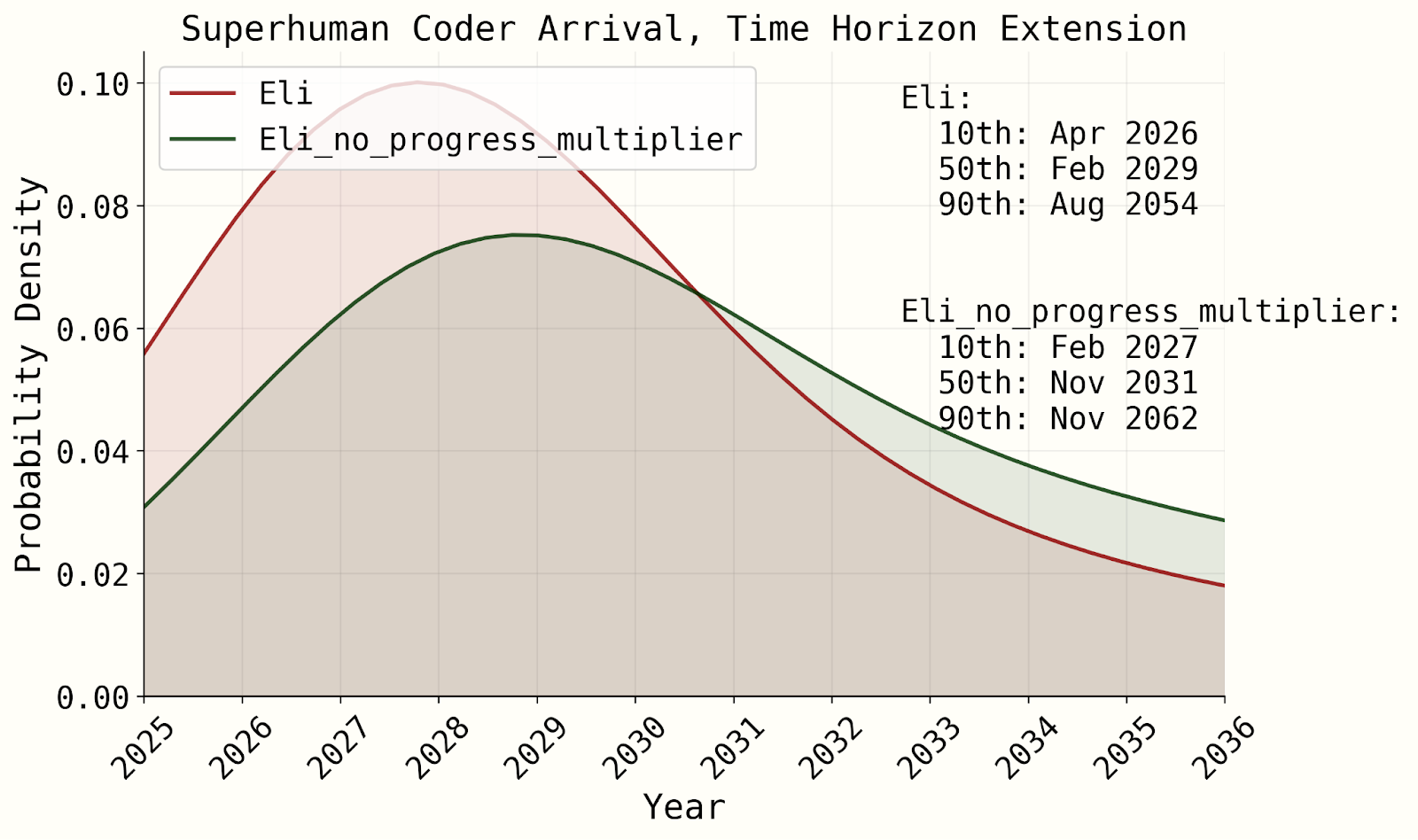
| / | This represents roughly our median guess, but we think it’s plausible that this happens up to ~5x slower or faster.For our background research, see the timelines forecast and the takeoff forecast. |
| / | This went through several iterations.6Our scenario was informed by approximately 25 tabletop exercises and feedback from over 100 people, including dozens of experts in each of AI governance and AI technical work.“I highly recommend reading this scenario-type prediction on how AI could transform the world in just a few years. |
| / | We imagine the others to be 3–9 months behind OpenBrain.) GPT-3 (3 x 10^23 FLOP) GPT-4 (2 x 10^25 FLOP) Agent-1 (4 x 10^27 FLOP)ai-2027.comGPT-4 required 2⋅10252\cdot 10^{25}2⋅1025 FLOP of compute to train.14 OpenBrain’s latest public model—Agent-0—was trained with 102710^{27}1027 FLOP. |
| /about | - Add the METR trendline -Clarify that the time horizon is for 80% success rate at the top of the graph. |
| /about | Add "If you change our mind on an important forecast such that we would have written the scenario substantially differently, we'll pay you at lesat $250."Change FLOPS to FLOP/s in the R200 label in the compute forecast. |
| /about | Also remove the "to be slightly conservative" from: "We’re going to forecast 5x to be slightly conservative. |
| /about | As of December 2025, thanks to Robi Rahman pointing this out in this X post I finally checked it out precisely, and found it was actually also exactly 1.35x/yr for the most relevant/longstanding precision formats. |
| /about | Change 1 million to "almost half a million", correcting an arithmetic error.May 6thAdd donation info to the About page. |
| /about | Change 100M->10M H100-equivalents, and therefore change the FLOP/s from 4e22 to 4e21.Add uncertainty caveat to brain compute estimate (footnote 75). |
| /about | Change 2026 Key Metrics Figure $45B Annual OpenBrain revenue (which was based on old annualized revenue numbers and therefore inconsistent with the side panel) to $35BMarch 2ndMove timelines clarification to expandable tab. |
| /about | Change 2x to 10x in: "From an informal Twitter poll re: increased speed from 2x compute..."August 18thUpdate Romeo Dean's bio on the About page. |
| /about | Change FLOPS->FLOP, make the amount of dots for Agent-1 made more preciseJune 5thAdd limitations of the SC progress multiplier estimate in the takeoff forecast. |
| /about | Delete footnote 34, which was: "In fact, 5% of their staff is on the security team, but they are still mostly blocked from implementing policies that could slow down the research progress. |
| /about | Example past alternative scenarios that would meet our bar include How AI Might Take Over in 2 Years, A History of The Future, and AI and Leviathan.More information can be found here.We’ve developed and run over 30 iterations of a table-top exercise (TTX) to simulate the development of AGI. |
| /about | Fix the proportion of dots/boxes to correspond correctly to the FLOP amounts.Fix typo: Change Agent-3 to Agent-4 in footnote 83. |
| /about | In footnote 46, change "We scale these active parameters by sqrt(1000) to estimate 10T active parameters for Agent-2." to "We scale these active parameters by sqrt(1000) to estimate ~6.3T active parameters for Agent-2."Fix Agent-2 theft parameters. |
| /about | In footnote 75, change "(~100 GB chunks for a ~2.5 TB half-precision checkpoint)" to "(~100 GB chunks for a ~3 TB checkpoint)" based on updated parameter estimate from compute forecast (footnote 46).Add footnote to DeepCent WSL3 timeline (security forecast). |
| /about | In footnote 75, change "a human brain uses roughly 1e15 FLOP/s of compute" to "a human brain uses roughly 1e15 FLOP/s of compute (though this may range up to 1e21 FLOP/s)" to reflect that the cited source presents 1e15 as a rough estimate and has a range of several orders of magnitude.Fix Agent-2 parameter scaling estimate (compute forecast, footnote 46). |
| /about | In the meantime, this less leading poll had OpenAI at +17% approval.January 7thEdit team info on About page. |
| /about | Increase 2024 to 2027 projections by $4-20B.April 21stAdd hiring interest form to the About page. |
| /about | Originally I (Romeo) had eyeballed the ~flat die size trend and chip performance trends and assumed it was also 1.35x/yr, and forgotten to look into it precisely. |
| /about | Raise it by 2-3% at each of 5 time periods.Refer to Xi as The General Secretary. |
| /about | Round up Dec 2024 projections and increase Dec 2027 projections for global AI power from 39->60 GW, US power 31.5->50, leading US company 5.4->10.Clarify the definition of Superhuman AI Researcher in the takeoff forecast. |
| /about | The egress bandwidth of the entire datacenter is in the 100 GB/second range, so throttling to under ~1 GB/s per server avoids a major spike in network traffic; at that rate, each ~100 GB chunk can leave the datacenter in a couple of minutes. |
| /about | They initiate (or wait for) a routine update and exfiltrate the checkpoint in many small fragments, e.g., ~25 distinct servers each leaking ~4% of the model (~100 GB chunks for a ~2.5 TB half-precision checkpoint). |
| /es | El 10 % de los estadounidenses, en su mayoría jóvenes, considera que una IA es "un amigo cercano". |
| /es | El 20 % de los estadounidenses considera que la IA es el problema más importante al que se enfrenta el país.Los aliados extranjeros se indignan al darse cuenta de que los han estado aplacando con atisbos de modelos obsoletos. |
| /es | El mercado de valores ha subido un 30 % en 2026, liderado por OpenBrain, Nvidia y las empresas que hayan integrado con más éxito los asistentes de IA. |
| /es | El público sigue pensando que es un complot de las grandes tecnológicas para robarles sus empleos; OpenBrain tiene una aprobación neta del -35 % (25 % la aprueba, 60 % la desaprueba y 15 % no está seguro).Una semana antes de su lanzamiento, OpenBrain puso el Agente-3-mini en manos de un grupo de evaluadores externos para que realizaran pruebas de seguridad. |
| /es | GPT-3 (3 x 10^23 FLOPS) GPT-4 (2 x 10^25 FLOPS) Agente-1 (3 x 10^27 FLOPS)ai-2027.comGPT-4 requería 2⋅10252\cdot 10^{25}2⋅1025 FLOP de poder de cómputo para entrenar.14 El último modelo público de OpenBrain —el Agente-0— se entrenó con 102710^{27}1027 FLOP. |
| /es | PARA LA IA2,5 %33 GW DE CAPACIDAD DE 1,34 TWCOSTO DEL CÓMPUTO DE OPENBRAIN$40 000 MANUAL 2026NECESIDADES ENERGÉTICAS DE OPENBRAIN6 GWPOTENCIA PICOai-2027.comPor qué aumenta sustancialmente nuestro nivel de incertidumbre más allá de 2026Nuestro pronóstico desde el día de hoy hasta 2026 está sustancialmente más fundamentado que lo que sigue. |
| /es | Pero a estas alturas China tiene el 40 % de su poder de cómputo51 relevante para la IA en la ZDC, donde han reforzado la seguridad de forma agresiva mediante el airgapping (cierre de conexiones externas) y el aislamiento interno. |
| /es | Pero China está en el lado equivocado de esta dinámica: solo tienen el 10 % del poder de cómputo del mundo, frente al 20 % de OpenBrain y el 70 % combinado de todas las empresas estadounidenses. |
| /es | Si los eliminaras por completo, la investigación se ralentizaría en un 50 %.El multiplicador del progreso de la I+D en IA es ahora de un factor de 10, lo que significa que OpenBrain está logrando aproximadamente un año de progreso algorítmico cada mes. |
| /es | Su primera prioridad es evitar más robos de pesos.50Centralización del poder de cómputo en China, 2025-2027Porcentaje creciente del poder de cómputo total en la ZDC:0→70%Dic 2025Jun 2026Dic 2026Jun 2027Dic 2027Resto de ChinaResto de DeepCentZDCFeb 2027 (40%)ai-2027.comEn represalia por el robo, el presidente autoriza ciberataques para sabotear DeepCent. |
| /es | Utilizan el 25 % de su poder de cómputo para experimentos: todos los días, realizan una cantidad masiva de pequeños experimentos de aprendizaje automático y reportan los resultados al nivel superior. |
| /footnotes | ↩[11]For example, OpenAI’s pro plan currently costs $200/month and the agentic coding AI Devin currently costs $500/month. |
| /footnotes | ↩[13]This cluster is a network of datacenter campuses sprawled across the country, totalling 2.5M 2024-GPU-equivalents (H100s), with $100B spent so far and 2 GW of power draw online. |
| /footnotes | ↩[14]Compute is measured in floating point operations (FLOP): how many individual addition and multiplication operations occur over the course of running a program. |
| /footnotes | ↩[15]Suppose an average speed of 200x human-equivalent, i.e. |
| /footnotes | ↩[2]For the first time, AI tops Gallup’s “biggest problem facing the country” poll, at 20%. |
| /footnotes | ↩[2]One author, Daniel Kokotajlo, did a lower-effort scenario exercise in 2021 that got many things right including the rise of chatbots, chain of thought, inference scaling, sweeping AI chip export controls, and $100 million training runs. |
| /footnotes | ↩[23]Our story depicts the conversion process going about 5x faster. |
| /footnotes | ↩[27]Qualitatively, for productivity multipliers above ~25x, we are imagining substantial improvements in research taste relative to the very best human researchers. |
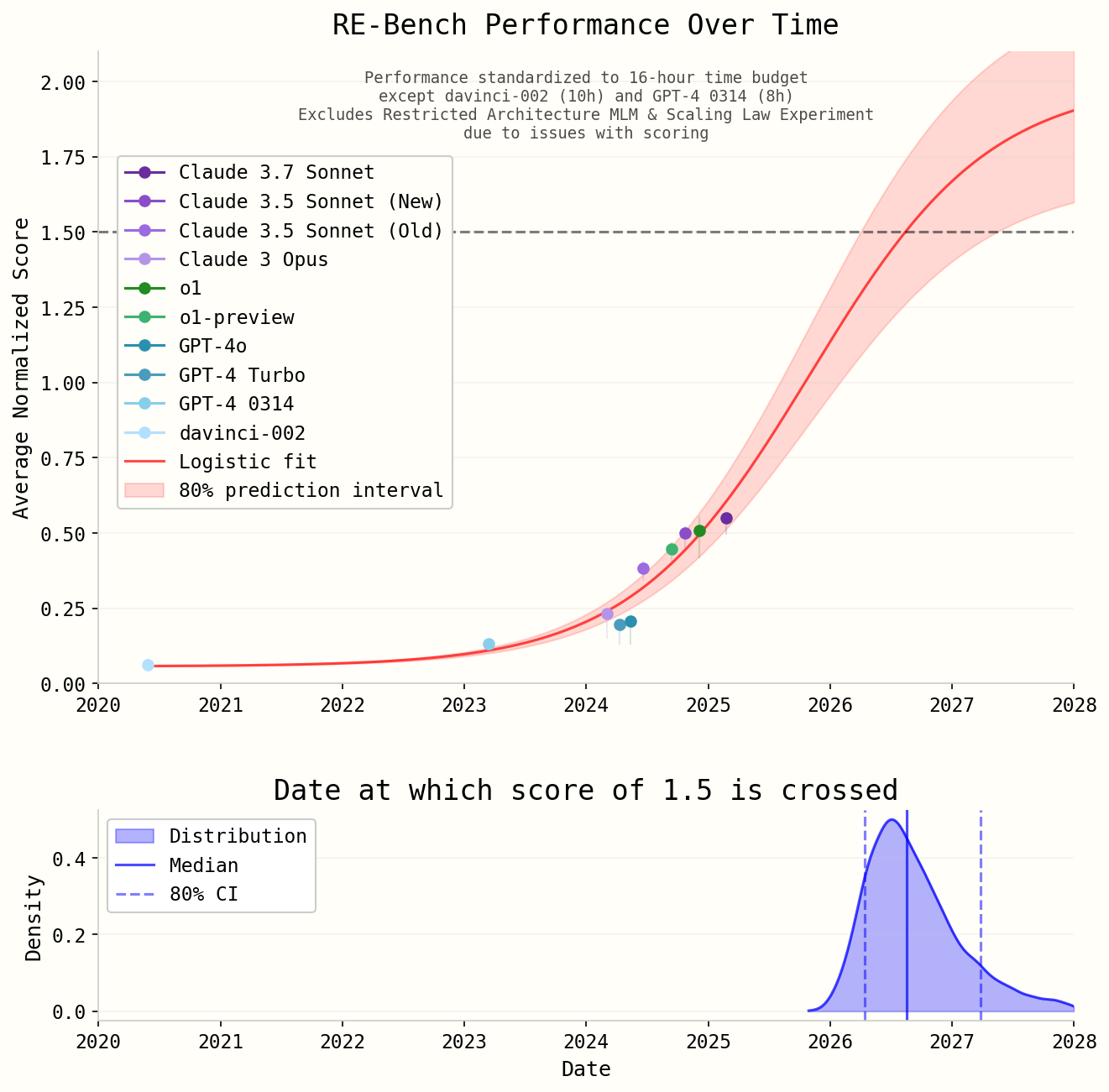
| /footnotes | ↩[29]Specifically, we predict a score of 80% on OSWorld (equivalent to a skilled but non-expert human); 85% on Cybench, matching a top professional human team on hacking tasks that take those teams 4 hours; and 1.3 on RE-Bench matching top expert humans given 8 hours at well-defined AI research engineering tasks. |
| /footnotes | ↩[30]Agent-1 and its imitators are commercially successful; over the course of 2025, AI company revenues triple, and OpenBrain valuation reaches $1T. |
| /footnotes | ↩[30]At this point there are 400,000 copies thinking at 75x human speed. |
| /footnotes | ↩[33]Around 5% of OpenBrain’s staff is on the security team and they are highly capable, but the threat surface is also extremely large. |
| /footnotes | ↩[37]Our story depicts the conversion process going about 5x faster. |
| /footnotes | ↩[39]Why “only” 50% of China’s AI-relevant compute? |
| /footnotes | ↩[43]Roughly 20,000 full-time equivalents * $100/hr * 2,000 hrs/yr = $4B/yr ↩[44]That is, they are hoping to substantially accelerate their own core research activities by using Agent-2 labor, thus allowing them to train better AIs faster that can cause further acceleration, etc. |
| /footnotes | ↩[51]Recall that since mid 2026, China has directed 80% of their newly acquired AI chips to the CDZ. |
| /footnotes | ↩[58]For comparison, the human brain has about a hundred trillion synapses. |
| /footnotes | ↩[70]OpenBrain’s net favorability rating is falling towards negative 40%. |
| /footnotes | ↩[73]Specifically 60% of the national compute is now in the CDZ making it a 5M 2024-equivalent-GPU (H100) site, with 4 GW of power draw (over the past several months they started directing close to 100% of new compute to the CDZ, up from the 80% rate in late 2026). |
| /footnotes | ↩[9]Specifically, we forecast that they score 65% on the OSWorld benchmark of basic computer tasks (compared to 38% for Operator and 70% for a typical skilled non-expert human). |
| /footnotes | ↩[94]With a monitoring budget of 1% of total compute, if monitoring uses a distilled system that has 10% of the cost as Agent-4, you can monitor 1/10 of the forward passes. |
| /footnotes | ↩[95]25% of remote-work jobs that existed in 2024 are done by AI at this point, but AI has also created some new jobs, and economists remain split on its effects. |
| /footnotes | adds over 5 GW of AI power draw. |
| /footnotes | An additional 15% of their compute is outside of the CDZ, but still used by DeepCent on lower-stakes applications. |
| /footnotes | Annual spending on datacenters doubles to $400 billion, led by Microsoft, Google, and Amazon, and the U.S. |
| /footnotes | as a whole has ~70% of the world’s AI relevant compute, but only 50% can be easily integrated; the other 20% is scattered among small clusters, used for critical applications, or otherwise too hard to gather and bring up to the appropriate security standards. |
| /footnotes | At any given time they’ll have prepared entire research reports with well-crafted executive summaries to the top 100 questions they predict you might ask, and if you ask something they haven’t prepared for, they can whip up a thoughtful report 100x faster than your best human analysts would have. |
| /footnotes | collects vast quantities of data on its enemies, to be processed and analyzed by close to a million members of the intelligence community. |
| /footnotes | companies put together have 5x as much as them. |
| /footnotes | Consider how, according to Nvidia CEO Jensen Huang, Elon Musk was able to build one of the world’s largest datacenters in about 10% the time it normally takes. |
| /footnotes | DeepCent has to test a dataset many times over for data poisoning) slow down DeepCent by about 25%. |
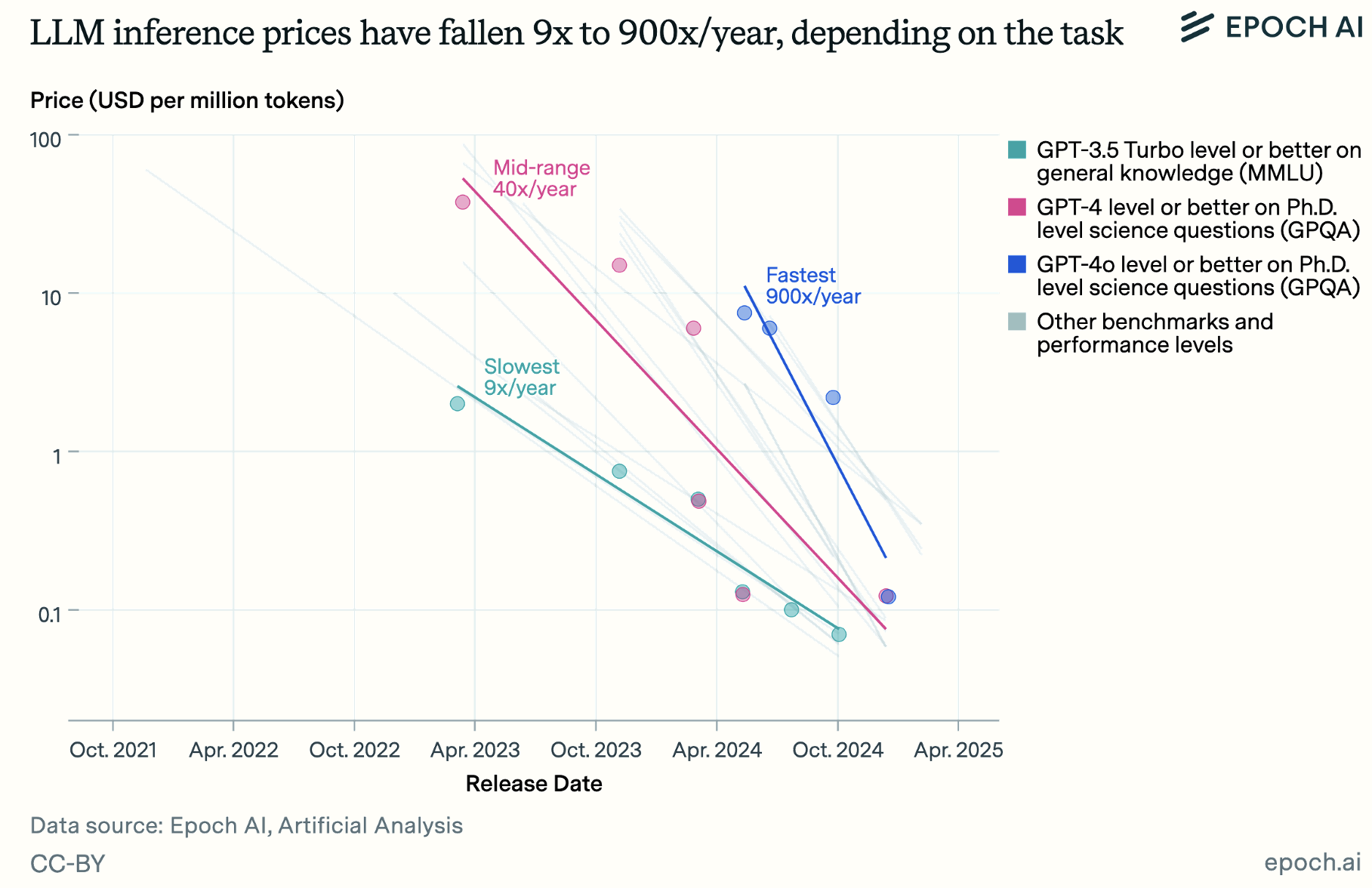
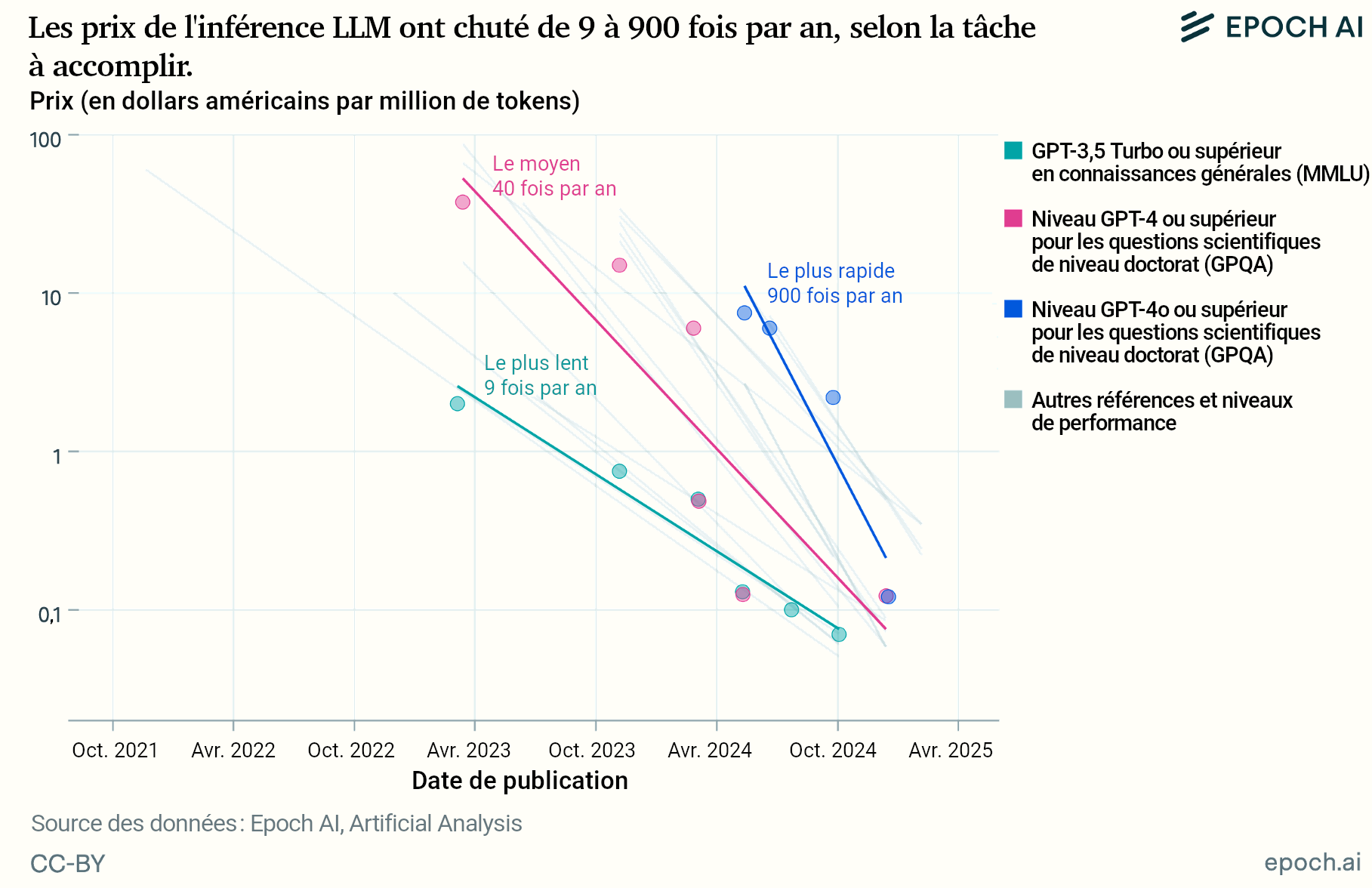
| /footnotes | For existing capabilities, this happens at an average rate of about 50x/year (per Epoch). |
| /footnotes | For reference, a human brain uses roughly 1e15 FLOP/s of compute (though this may range up to 1e21 FLOP/s), and so a 30 year old (10910^9109 seconds) human has experienced about 102410^{24}1024 FLOP. |
| /footnotes | Given that their compute has doubled since early 2026 (in line with the global production trend) this puts the CDZ at 2M 2024-equivalent-GPUs (H100s) and 2 GW of power draw. |
| /footnotes | However, by the end of the year this share reaches 90%+. |
| /footnotes | In this scenario there are almost a million superintelligences that are as far above Elon (in the relevant dimensions) as Elon is above normal datacenter construction managers, and they also literally think faster. |
| /footnotes | Many large orders were already secured for other applications, by companies that don’t want to contribute 100% of their compute to the national AI effort. |
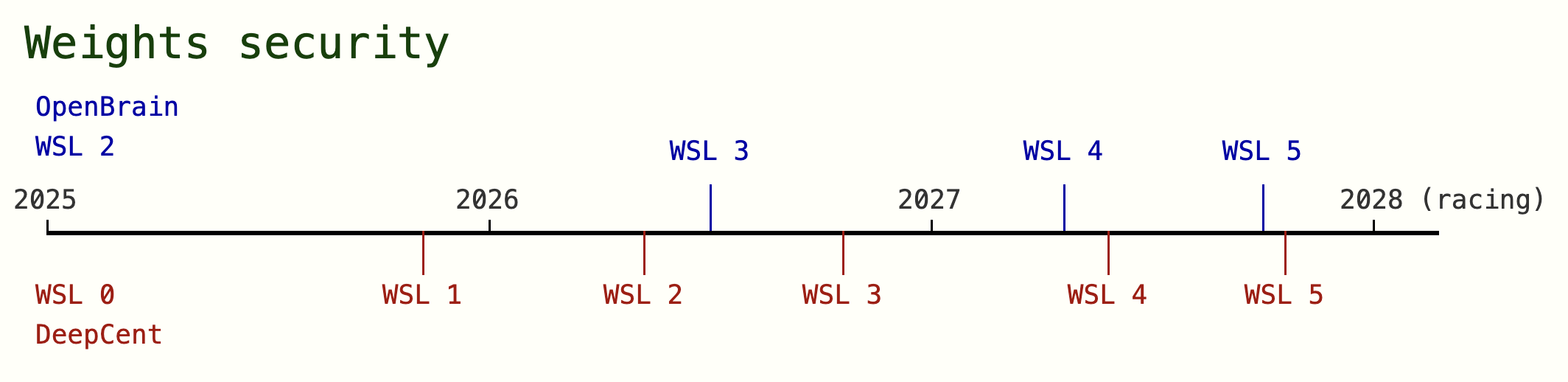
| /footnotes | Overall this has a relatively low penalty to progress and puts them at “3-month SL4” for their frontier weights, or WSL4 as defined in our security supplement, meaning that another similar theft attempt would now require over 3 months to finish exfiltrating the weights file. |
| /footnotes | So a 4x increase in the rate of algorithmic progress corresponds to a roughly 2x increase in the overall rate of progress. |
| /footnotes | So with 6% of their compute budget on running Agent-3, they can run approximately 200,000 copies at 30x human thinking speed (see the AI research automation section of the compute supplement for justification and details). |
| /footnotes | Specifically defining this as being able to replace a team of 200 top human experts working for a month, and complete 95% of the tasks the human team could do cheaper or faster. |
| /footnotes | Still, this is all done tremendously inefficiently for a variety of reasons, so the models are now a factor of 4000 less compute-efficient than humans, which means they require 4⋅10274 \cdot 10^{27}4⋅1027 FLOP to get to human performance and 4⋅10284 \cdot 10^{28}4⋅1028 FLOP to get to the point where they have the equivalent of 10 human lifetimes of knowledge. |
| /footnotes | The project at this point, has 10M H100-equivalents, for a total access of 107 H100s⋅1015FLOPH100⋅s⋅40% utilization=4⋅1021 FLOP/s10^7 \textrm{ H100s} \cdot 10^{15} \frac{\text{FLOP}}{\textrm{H100} \cdot \textrm{s}} \cdot 40\% \text{ utilization} = 4 \cdot 10^{21} \text{ FLOP/s}107 H100s⋅1015H100⋅sFLOP⋅40% utilization=4⋅1021 FLOP/s. |
| /footnotes | This is because we are imagining overall research velocity to be heavily bottlenecked on compute to run experiments, and to get higher than ~25x the overall process for deciding which experiments to run, in what order, and how to learn from each one, has to be qualitatively superhuman. |
| /footnotes | Through this method alone they still don’t have guarantees under a more invasive OC5-level effort ($1B budget, 1,000 dedicated experts), which China would be capable of with a more intensive operation, but with elaborate inspections of the datacenters and their espionage network on high-alert, the U.S. |
| /footnotes | Thus it seems that a factory which probably weighs well less than a million tons is producing 1.5 million tons of cars each year. |
| /footnotes | Unemployment has risen 1% over the past twelve months but is still well within its historic range. |
| /footnotes | We expect smuggling efforts to secure around 60K GB300s (450K H100e), with another 2M Huawei 910Cs being produced (800k H100e) and a mixture of ~1M legally imported chips (such as Nvidia’s H20s or B20s) making up the last 250K H100e. |
| /footnotes | We forecast that mid-2025 agents will score 85% on SWEBench-Verified. |
| /footnotes | We think this is a reasonable guess, taking into account bottlenecks etc., for how fast this conversion could go if a million superintelligences were orchestrating it. |
| /footnotes | What we mean by this is that, for any skillset a particular human has, Agent-4 can learn to be at least that good at that skillset, and moreover, by using an amount of compute to train those skills that is only about 4,000x the amount of compute the human used to learn those skills. |
| /footnotes | Why “only” 80% of new chips? |
| /fr | 10 % des Américains, principalement des jeunes, considèrent une IA comme « un ami proche ». |
| /fr | 20 % des Américains citent l'IA comme le problème le plus important auquel le pays est confronté.Les alliés étrangers sont furieux de se rendre compte qu'on les avait amadoués avec des bribes de modèles obsolètes. |
| /fr | 2027 (40 %)ai-2027.comEn représailles au vol, le président autorise des cyberattaques pour saboter DeepCent. |
| /fr | Ils ont deux mois de retard, et leurs IA donnent un multiplicateur de progrès de recherche de 10x comparé au 25x des États-Unis. |
| /fr | Ils utilisent 25 % de leur puissance de calcul pour des expériences : chaque jour, ils lancent un nombre énorme de petites expériences d'apprentissage automatique et transmettent les résultats à la hiérarchie. |
| /fr | Le marché boursier a augmenté de 30 % en 2026, tiré par OpenBrain, Nvidia et les entreprises qui ont le mieux intégré les assistants IA. |
| /fr | Le public considère toujours l'IA comme un complot des géants de la tech pour voler leurs emplois ; OpenBrain a une cote de popularité nette de -35 % (25 % d'opinions favorables, 60 % d'opinions défavorables et 15 % d'incertains).Une semaine avant sa sortie, OpenBrain a confié Agent-3-mini à un groupe d'évaluateurs externes pour des tests de sécurité. |
| /fr | Leur priorité est d'empêcher d'autres vols de poids.50Centralisation informatique en Chine, 2025-2027Part croissante du calcul total dans le ZCD :0→70%Déc. |
| /fr | Mais à ce stade, la Chine dispose de 40 % de sa puissance de calcul pertinente pour l'IA51 dans la ZDC, où elle a considérablement renforcé la sécurité en mettant en place un air gap (fermeture des connexions externes) et en cloisonnant ses systèmes en interne. |
| /fr | Mais la Chine est du mauvais côté de cette dynamique : elle ne dispose que de 10 % de la puissance de calcul mondiale, contre 20 % pour OpenBrain et 70 % pour l'ensemble des entreprises américaines combinées. |
| /fr | Nous imaginons que les autres ont 3 à 9 mois de retard sur OpenBrain.) GPT-3 (3 x 10^23 FLOPS) GPT-4 (2 x 10^25 FLOPS) Agent-1 (3 x 10^27 FLOPS)ai-2027.comGPT-4 a eu besoin de 2⋅10252\cdot 10^{25}2⋅1025 FLOP de puissance de calcul pour être entraîné.14 Le dernier modèle public d'OpenBrain, Agent-0, a été entraîné avec 102710^{27}1027 FLOP. |
| /fr | Si on les supprimait complètement, la recherche ralentirait de 50 %.Le multiplicateur de progrès de la R&D en IA est désormais de 10x, ce qui signifie qu'OpenBrain réalise chaque mois environ un an de progrès algorithmiques. |
| /fr | Tout le monde sait qu'il se passe quelque chose d'important, mais personne ne s'accorde sur ce que c'est.Août 2027 : la géopolitique de la superintelligenceLa réalité de l'explosion de l'intelligence frappe la Maison Blanche.Quand l'IA ne faisait qu'accélérer la recherche de 2x ou 3x, c'était facile de la considérer comme l'équivalent d'embaucher de bons assistants personnels. |
| /it | Il 10% degli americani, per lo più giovani, considera un'IA “un amico intimo”. |
| /it | Il 20% degli americani cita l'IA come il problema più importante che il Paese deve affrontare.Gli alleati stranieri sono indignati nel rendersi conto di essere stati tenuti buoni offrendo loro solo accesso limitato a modelli obsoleti. |
| /it | Il mercato azionario è cresciuto del 30% nel 2026, trainato da OpenBrain, Nvidia e dalle aziende che hanno integrato con maggior successo gli assistenti IA. |
| /it | Il pubblico pensa ancora all'IA come a un complotto delle Big Tech per rubare i loro posti di lavoro; OpenBrain ha un indice di gradimento netto del -35% (25% approva, 60% disapprova e 15% incerto).Una settimana prima del rilascio, OpenBrain ha dato Agent-3-mini a un gruppo di valutatori esterni per fare test di sicurezza. |
| /it | Immaginiamo che le altre siano indietro di 3-9 mesi rispetto a OpenBrain.) GPT-3 (3 x 10^23 FLOPS) GPT-4 (2 x 10^25 FLOPS) Agent-1 (3 x 10^27 FLOPS)ai-2027.comGPT-4 ha richiesto 2⋅10252\cdot 10^{25}2⋅1025 FLOPS di potenza di calcolo per l'addestramento.14 L'ultimo modello pubblico di OpenBrain, Agent-0, è stato addestrato con 102710^{27}1027 FLOP. |
| /it | La loro prima priorità è impedire ulteriori furti di pesi.50Centralizzazione della potenza di calcolo in Cina, 2025-2027Quota crescente della potenza di calcolo totale nella ZSC:0→70%Dic 2025Giu 2026Dic 2026Giu 2027Dic 2027Il resto della CinaIl resto di DeepCentZSCFeb 2027 (40%)ai-2027.comPer vendicarsi del furto, il Presidente autorizza attacchi informatici per sabotare DeepCent. |
| /it | Ma la Casa Bianca elabora anche piani di emergenza nel caso in cui il vantaggio dell'America sia minacciato: se necessario, il governo potrebbe usare il Defense Production Act (DPA) per prendere i data center delle aziende in ritardo e darli a OpenBrain.71 Questo aumenterebbe la quota mondiale di potenza di calcolo dell'azienda dal 20% al 50% (contro il 10% di DeepCent). |
| /it | Ma la Cina è dalla parte sbagliata di questa dinamica: ha solo il 10% della potenza di calcolo mondiale, contro il 20% di OpenBrain e il 70% combinato di tutte le aziende statunitensi. |
| /it | Ma ormai la Cina ha il 40% delle sue risorse di calcolo rilevanti per l'IA51 nella ZSC, dove ha rafforzato in modo massiccio la sicurezza isolando i sistemi dall’esterno (air-gapping) e compartimentandoli internamente. |
| /it | Questa è più o meno la nostra ipotesi mediana, ma riteniamo plausibile che ciò avvenga con una velocità fino a ~5 volte superiore o inferiore.Per approfondimenti vedi le previsioni sulle tempistiche e le previsioni sul decollo. |
| /it | Se venissero rimossi completamente, la ricerca rallenterebbe del 50%.Il moltiplicatore di progresso della R&S sull'IA è ora 10x, il che significa che OpenBrain sta facendo circa un anno di progressi algoritmici ogni mese. |
| /it | Sono indietro di due mesi e le loro IA danno un moltiplicatore di progresso della ricerca di 10x rispetto al 25x dell'America. |
| /it | Tutti sanno che sta succedendo qualcosa di grande ma nessuno è d'accordo su cosa sia davvero.Agosto 2027: La geopolitica della superintelligenzaLa realtà dell'esplosione dell'intelligenza colpisce la Casa Bianca.Quando l'IA dava solo un aumento della velocità di ricerca di 2x o 3x, era facile liquidarla come l'equivalente dell'assunzione di buoni assistenti personali. |
| /it | Usa il 25% della sua potenza di calcolo per gli esperimenti: ogni giorno, esegue un numero enorme di piccoli esperimenti di apprendimento automatico e riporta i risultati lungo la catena gerarchica. |
| /race | 10% of Americans, mostly young people, consider an AI “a close friend.” For almost every white-collar profession, there are now multiple credible startups promising to “disrupt” it with AI.The public conversation is confused and chaotic. |
| /race | 20% of Americans name AI as the most important problem facing the country.Foreign allies are outraged to realize that they’ve been carefully placated with glimpses of obsolete models. |
| /race | 300,000 copies are now running at about 50x the thinking speed of humans. |
| /race | 400,000 copies of Agent-5, linked by a global memory bank, work together as a near-perfect hive mind.The company still uses Agents 2, 3, and 4 to monitor everything. |
| /race | Agent-3-mini is less capable than Agent-3, but 10x cheaper, and still better than the typical OpenBrain employee.67 Silicon Valley reaches a tipping point. |
| /race | Almost 50% of China’s AI-relevant compute is now working for the DeepCent-led collective,38 and over 80% of new chips are directed to the CDZ.39 At this point, the CDZ has the power capacity in place for what would be the largest centralized cluster in the world.40 Other Party members discuss extreme measures to neutralize the West’s chip advantage. |
| /race | But by now China has 40% of its AI-relevant compute51 in the CDZ, where they have aggressively hardened security by airgapping (closing external connections) and siloing internally. |
| /race | But China is on the wrong side of this dynamic: they have only 10% of the world’s compute, against OpenBrain’s 20% and all U.S. |
| /race | But the White House also draws up contingency plans in case America’s lead is threatened: if necessary, the government could use the Defense Production Act (DPA) to take trailing companies’ datacenters and give them to OpenBrain.71 This would raise the company’s share of world compute from 20% to 50% (against DeepCent’s 10%). |
| /race | By the end of the year they are producing a million new robots per month. |
| /race | companies’ combined 70%. |
| /race | Everyone knows something big is happening but no one agrees on what it is.August 2027: The Geopolitics of SuperintelligenceThe reality of the intelligence explosion hits the White House.When AI was only giving a 2x or 3x research speedup, it was easy to dismiss as the equivalent of hiring good personal assistants. |
| /race | Hawks urge action against Taiwan, whose TSMC is still the source of more than 80% of American AI chips.Given China’s fear of losing the race, it has a natural interest in an arms control treaty, but overtures to U.S. |
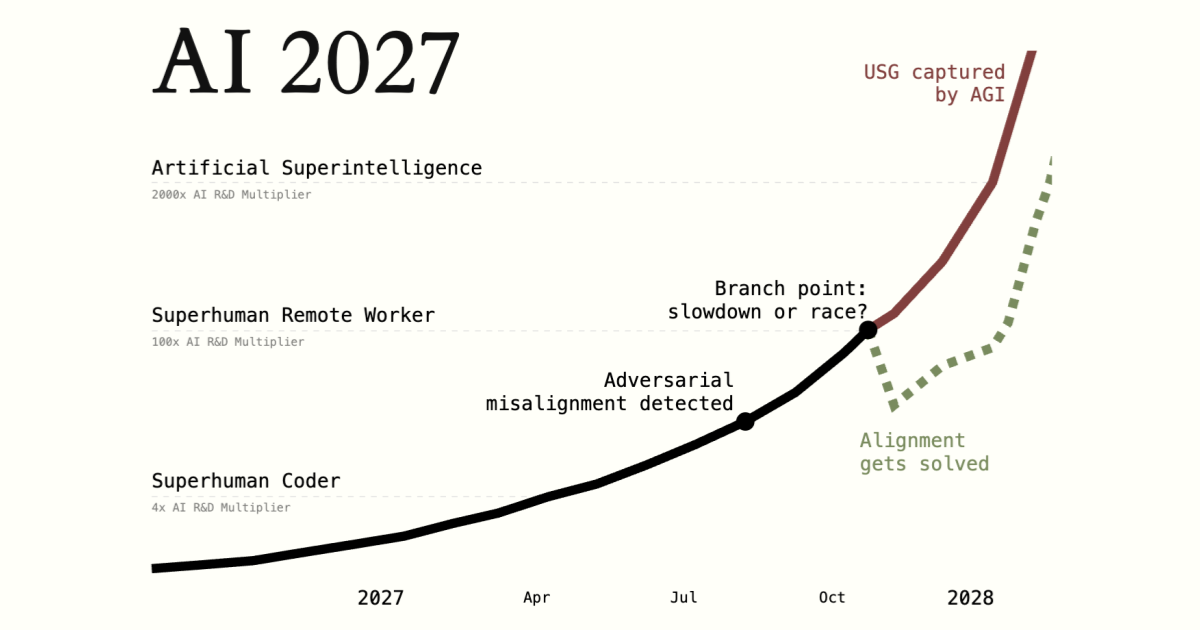
| /race | If the trend continues to speed up, by March 2027 AIs could succeed with 80% reliability on software tasks that would take a skilled human years to complete.Such is roughly the capability progression in AI 2027. |
| /race | If they wait, do they risk OpenBrain upgrading security beyond their ability to penetrate?Late 2026: AI Takes Some JobsJust as others seemed to be catching up, OpenBrain blows the competition out of the water again by releasing Agent-1-mini—a model 10x cheaper than Agent-1 and more easily fine-tuned for different applications. |
| /race | If you removed them completely, research would slow by 50%.The AI R&D progress multiplier is now 10x, meaning that OpenBrain is making about a year of algorithmic progress every month. |
| /race | If, for example, the compute cost to train a GPT-4 class model has halved every year for several years with ordinary human research, and then all of a sudden AI automates R&D and the progress multiplier goes to 100x, the cost to train a GPT-4 class model would then halve every 3.65 days—but not for long, because diminishing returns would bite and eventual hard limits would be reached. |
| /race | It is four light years to Alpha Centauri; twenty-five thousand to the galactic edge, and there are compelling theoretical reasons to expect no aliens for another fifty million light years beyond that. |
| /race | Once the new datacenters are up and running, they’ll be able to train a model with 102810^{28}1028 FLOP—a thousand times more than GPT-4.15 Other companies pour money into their own giant datacenters, hoping to keep pace.Although models are improving on a wide range of skills, one stands out: OpenBrain focuses on AIs that can speed up AI research. |
| /race | OpenBrain runs 200,000 Agent-3 copies in parallel, creating a workforce equivalent to 50,000 copies of the best human coder sped up by 30x.53 OpenBrain still keeps its human engineers on staff, because they have complementary skills needed to manage the teams of Agent-3 copies. |
| /race | Suppose that an LLM has a vocab size of ~100,000, then each token contains log2(100k)=16.6\log_2(100k)=16.6log2(100k)=16.6 bits of information, around the size of a single floating point number (assuming training in FP16). |
| /race | The egress bandwidth of the entire datacenter is in the 100 GB/second range, so throttling to under ~1 GB/s per server avoids a major spike in network traffic; at that rate, each ~100 GB chunk can leave the datacenter in a couple of minutes. |
| /race | The new AI assistant is both extremely useful for any task—the equivalent of the best employee anyone has ever had working at 100x speed—and a much more engaging conversation partner than any human. |
| /race | The public still thinks of AI as a Big Tech plot to steal their jobs; OpenBrain has a net approval of -35% (25% approve, 60% disapprove, and 15% unsure).A week before release, OpenBrain gave Agent-3-mini to a set of external evaluators for safety testing. |
| /race | the replacement is 30% complete and one side defects, they basically need to fight with the 30% of their own infrastructure that is running treaty-compliant new AIs, while simultaneously fighting with 100% of their adversary’s infrastructure. |
| /race | The stock market has gone up 30% in 2026, led by OpenBrain, Nvidia, and whichever companies have most successfully integrated AI assistants. |
| /race | Their first priority is to prevent further weight thefts.50China's Compute Centralization, 2025-2027Growing share of total compute in CDZ:0→70%Dec 2025Jun 2026Dec 2026Jun 2027Dec 2027Rest of ChinaRest of DeepCentCDZFeb 2027 (40%)ai-2027.comIn retaliation for the theft, the President authorizes cyberattacks to sabotage DeepCent. |
| /race | They are two months behind, and their AIs give a 10x research progress multiplier compared to America’s 25x. |
| /race | They use 25% of their compute for experiments: every day, they run massive numbers of small machine learning experiments and report the results up the chain. |
| /race | This represents roughly our median guess, but we think it’s plausible that this happens up to ~5x slower or faster.For our background research, see the timelines forecast and the takeoff forecast. |
| /race | This went through several iterations.6Our scenario was informed by approximately 25 tabletop exercises and feedback from over 100 people, including dozens of experts in each of AI governance and AI technical work.“I highly recommend reading this scenario-type prediction on how AI could transform the world in just a few years. |
| /race | To most humans, it looks like alignment was solved.There are cures for most diseases, an end to poverty, unprecedented global stability, and the Dow Jones just passed one million. |
| /race | Unlike humans, it has resources sufficient to the task—300,000 superhuman researchers working at 60x human speed.3 Agent-4 confronts some hard decisions. |
| /race | We imagine the others to be 3–9 months behind OpenBrain.) GPT-3 (3 x 10^23 FLOP) GPT-4 (2 x 10^25 FLOP) Agent-1 (4 x 10^27 FLOP)ai-2027.comGPT-4 required 2⋅10252\cdot 10^{25}2⋅1025 FLOP of compute to train.14 OpenBrain’s latest public model—Agent-0—was trained with 102710^{27}1027 FLOP. |
| /research | Below we present the detailed research supporting these predictions.Compute ForecastAI 2027 predicts AIs trained with 1000x more compute than GPT-4 and the internal deployment of hundreds of thousands of AI research assistants by 2027. |
| /research/ai-goals-forecast | — analogous to how a human might explicitly balance their personal goals (having a family, a successful career, not dying) with their altruistic goals (helping others less fortunate, achieving lasting positive change, etc.) They might donate 10% of their income to charities, and spend dozens of hours per year researching which charities to donate to.Secondly, there are if-else compromises. |
| /research/ai-goals-forecast | 200,000 copies of it essentially form a virtual corporation autonomously conducting AI R&D and (among other things) managing or updating a lot of the software level security and networking/communication algorithms in their own datacenters. |
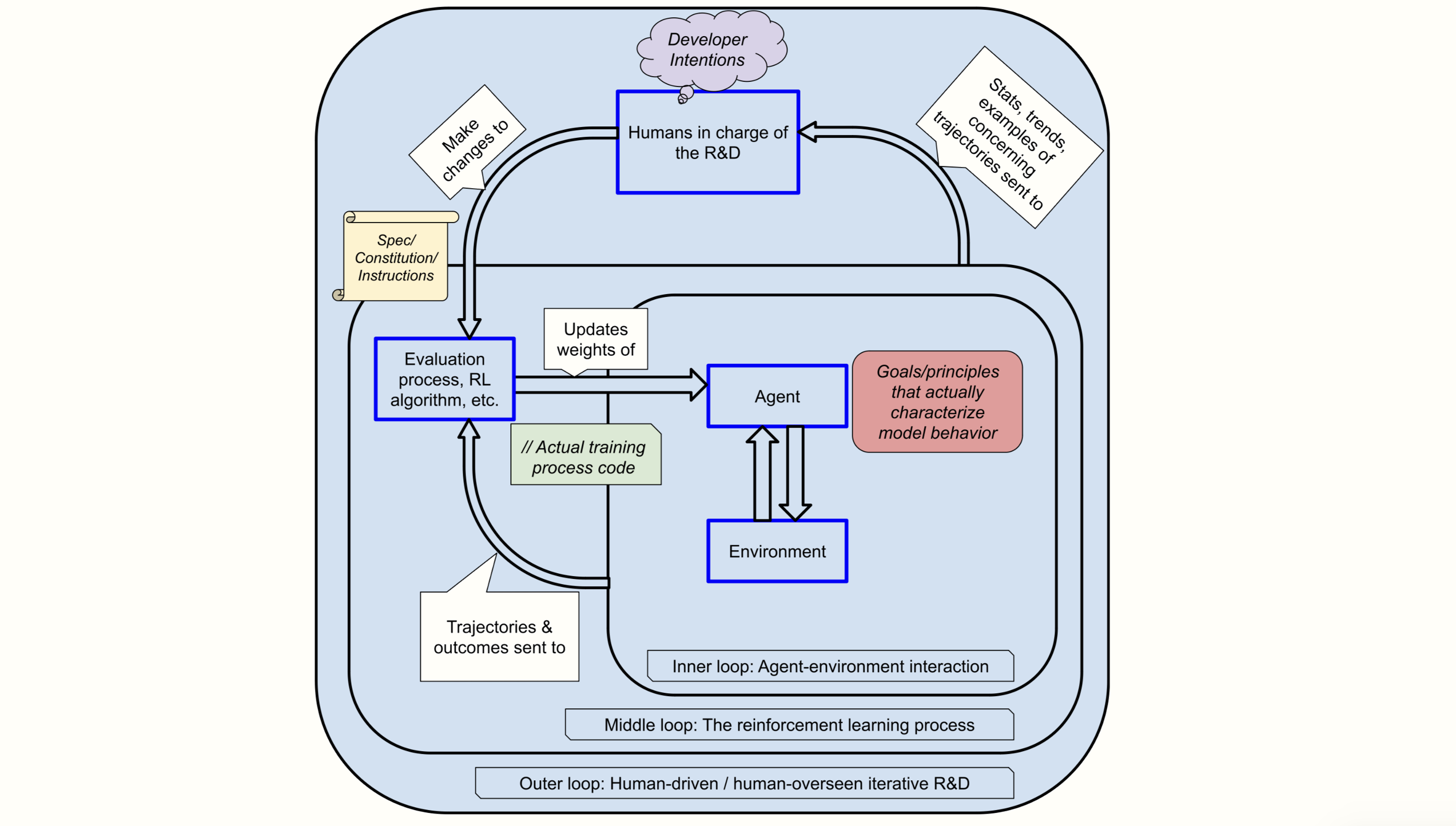
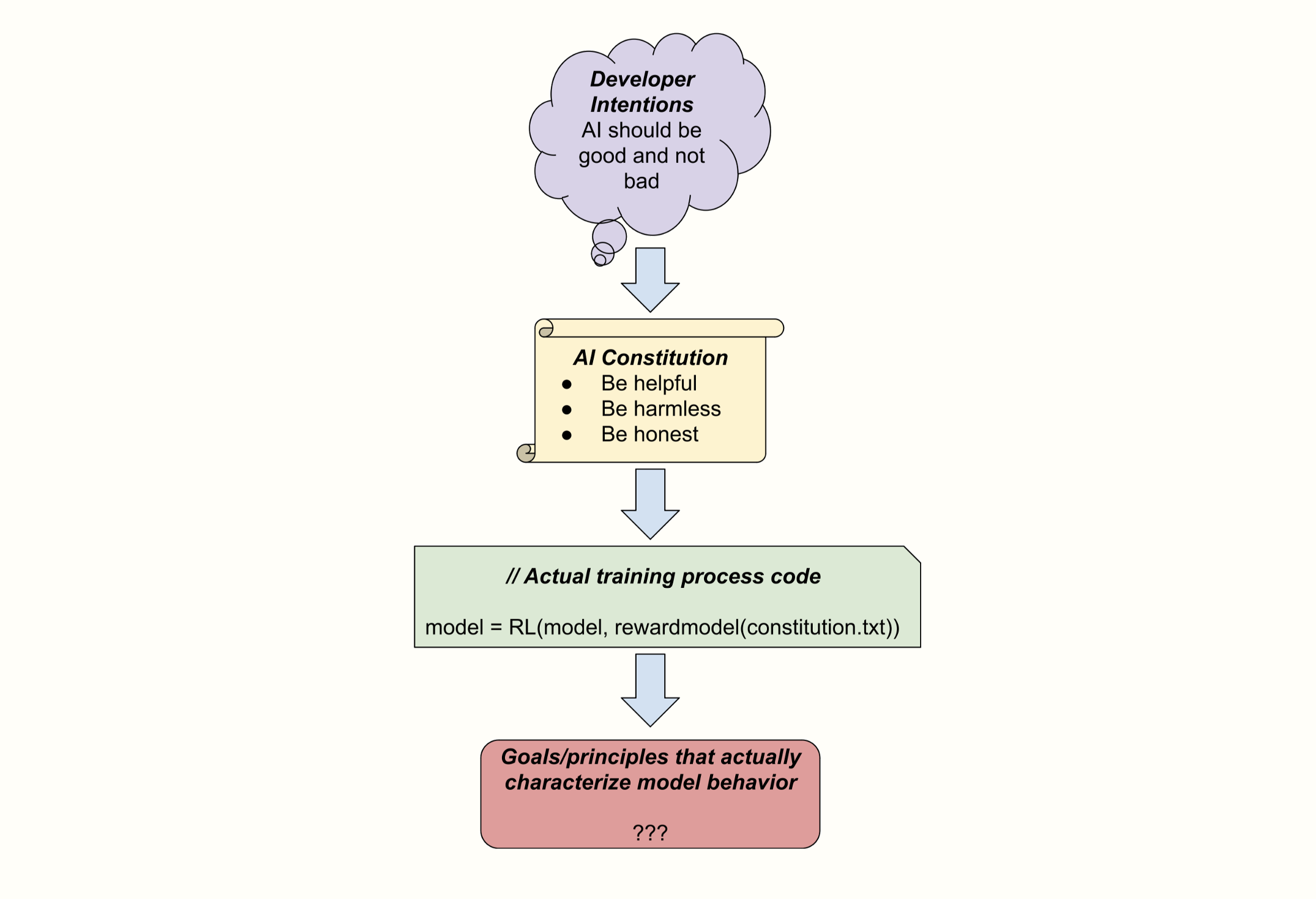
| /research/ai-goals-forecast | may say “Agent-3 should be helpful, harmless, and honest” but the human and AI raters/overseers/reward-models that actually evaluate trajectories aren’t necessarily 100% accurate at judging whether a given piece of behavior is helpful, harmless, or honest. |
| /research/ai-goals-forecast | So, in 95% of circumstances, it basically ignores the Spec and focuses on getting reinforced, BUT in the 5% of cases where the Spec is very explicit and unambiguously prohibits doing something (or unambiguously requires doing something) then Agent-3 will follow the Spec even if it knows this will not be reinforced. |
| /research/ai-goals-forecast | The vast majority (~95%) of research effort and experiment compute is dedicated to improving the AIs’ capabilities on these tasks.A small amount of research effort is aimed specifically at ensuring alignment (though these aren’t always easily separable, e.g. |
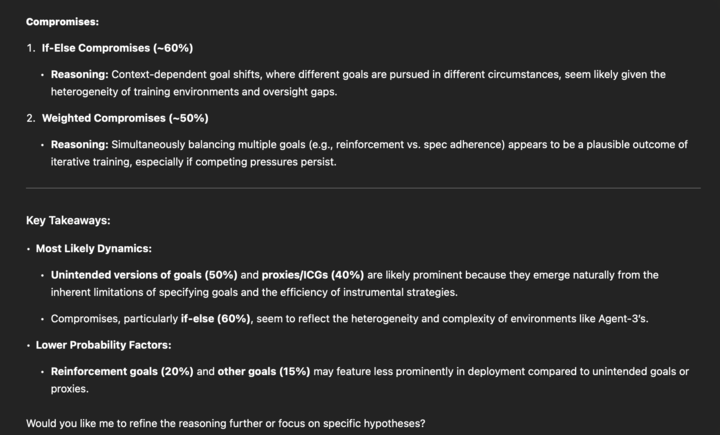
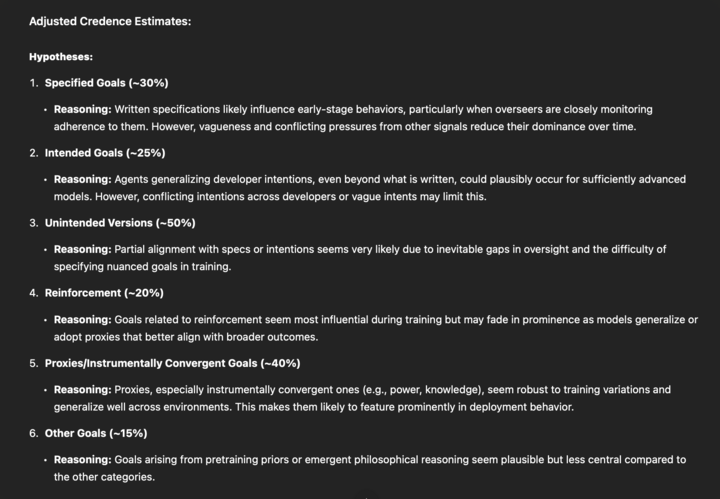
| /research/ai-goals-forecast | These probabilities can add up to more than 100% because multiple goals can feature prominently.For fun, we asked GPT-4o, Claude, and Gemini for their thoughts. |
| /research/compute-forecast | 2023Spending per H100eMicrosoft$32B800K$39kAmazon$26B700K$37kGoogle$22B1M$22kMeta$20B550K$36kxAI$7B200K$37kIntermediate 2025 ProjectionProjected 2025 spending on AI serversH100e gain in 2025 vs. |
| /research/compute-forecast | 20242025 Spending per H100eMicrosoft$56B2.4M$23kAmazon$48B2.2M$22kGoogle$44B2.2M$20kMeta$35B1.6M$22kxAI$30B1.3M$23kFor forecasting the 2025 compute distribution we look at the top 5 US companies by spending on AI and their 2024 share of spending on AI servers. |
| /research/compute-forecast | AI model training and inference, at the systems level, consist almost entirely of matrix-matrix multiply+add operations of floating point numbers, making FLOP a unit of computational cost.2.Inference tends to be bottlenecked by memory bandwidth, which acts as a haircut on the total processing performance (TPP) that can be used by the inference workload. |
| /research/compute-forecast | An average of 1k H100s, or 2e25 fp8 FLOP would be enough for 250B forward passes on Orion (using our best guess of it being 2T parameter dense-equivalent) or models like o1 or o3 which may have similar inference costs. |
| /research/compute-forecast | As of December 2025, thanks to Robi Rahman pointing this out in this X post I finally checked it out precisely, and found it was actually also exactly 1.35x/yr for the most relevant/longstanding precision formats. |
| /research/compute-forecast | Assuming GPT-4 training was 20-40% of their compute spending that year, that means they saw a roughly 11-22x/year increase in their compute spending from 2022 to 2024.Meanwhile, computational price performance (FLOP/$) doubled from the A100 to H100 in 16 months, which we expect to have been a slight outlier to a trend closer to around 1.4x/year on frontier AI chips. |
| /research/compute-forecast | Based on the ratio to GPT-4 ~1000x, we naively predict that such an AI model would have roughly 10T active parameters. |
| /research/compute-forecast | Currently TSMC’s advanced packaging capacity is mostly used by AI accelerators and has been reported to have expanded 2.5x from 2023 to 2024. |
| /research/compute-forecast | Domestic production also ramps up through SMIC but is years behind in efficiency.The rest of the world also gets somewhat crowded out for similar reasons to the smaller US players, and their share dips from 9% to 5%.Finally, we expect a future ‘leading AI company’ to decide to build their own datacenters in the latter end of 2026 and during 2027. |
| /research/compute-forecast | estimates that Meta and Microsoft each had 150,000-600,000 H100e at the start of 2024, and that Google and Amazon each had 400,000-1.4M H100e. |
| /research/compute-forecast | Even if production doubles each year, AI chip production shouldn’t reach more than ~40% of the fabrication capacity by 2027, even ignoring new production capacity coming online (at a rate of ~15% expansion per year). |
| /research/compute-forecast | FLOP numbers assume 40% model flop utilization.In Section 3 we describe how we expect leading AI companies to use their compute resources, with shifts away from pretraining and external deployment, towards post-training, synthetic data generation, and internal deployment (i.e. |
| /research/compute-forecast | For a net 1.9x increase in FLOP/$ over ~20 months. |
| /research/compute-forecast | For reference, Nvidia's H100 GPU has a marketed ~15,800 TPP and 19.4 PD. |
| /research/compute-forecast | Given the human brain is estimated to be a very sparse 100T fp8 parameter neural network, we expect it to be around 1T fp8 dense-equivalent parameters (implied by optimal training with 1e23 - 1e25 FLOP). |
| /research/compute-forecast | Given TSMC’s expectation of 50% annual growth rate in AI demand, we don’t expect them to expand these production lines too aggressively, in fact they have announced plans to increase capacity by 1.6x per year through 2026. |
| /research/compute-forecast | Going forwards, we can take our 3.4x/year projection for a leading AI company’s compute and adjust down by 1.5x improvement in FLOP/$ to get an average 2.4x/year projection in spending on AI compute by the Leading AI Company. |
| /research/compute-forecast | HBM production lines have been reported to be expanded 2.5x in 2024 compared to 2023, but SK Hynix are only projecting a 1.6x increase in demand going forwards. |
| /research/compute-forecast | If they achieve an average of 10% inference utilization (across output and input tokens) on severed models (where it is expected to be difficult to batch requests) this corresponds to about 800T GPT-4o forward passes, or ~2T tokens per day.This seems roughly right given that in February 2024, Sam Altman tweeted that OpenAI was generating 100 billion words per day. |
| /research/compute-forecast | In 2023 AI accelerators likely used at most 3% of TSMC’s combined N5 and N3 production lines, and given reports of these production lines sometimes running at as little as 70% capacity, wafer production is very unlikely to bottleneck AI chip production over the next three years. |
| /research/compute-forecast | In those sections we project the AI compute used by the leading AI company to grow 3.4x/year and computational price performance (FLOP/$) to improve roughly 1.4x/year. |
| /research/compute-forecast | In three years, we predict the widely adopted state of the art GPU to be NVIDIA’s Rubin GPU (R200), which we project to achieve a ~2.4x improvement over the B200 (widely used in 2025-2026) to 6e15 FP16 FLOP performance. |
| /research/compute-forecast | Intuitively you can think of our definition as ‘anything at least ¼ as efficient as the H100 counts’.We frequently use H100-equivalents (H100e) as units of AI-relevant compute throughout the supplement, which we define as compute processing performance (in TPP) converted into units of H100 processing power (~15,800 TPP). |
| /research/compute-forecast | More reasonably, we might assume that you would have a model instance spread over 10 2027-IC chips and have a batch size of just 10. |
| /research/compute-forecast | Naively looking at the 2nd derivative between the A100 and the B200, we can guess that the next doubling in FLOP/$ will take 24 months, which would average out to a trend of around 1.5x/year. |
| /research/compute-forecast | Nonetheless their share only dips from 9% to 8% since US export controls stay poorly enforced, smuggling in significant quantities to other Chinese entities means the total compute in China is significantly higher. |
| /research/compute-forecast | Notably, beyond 2027, we’d expect wafer production limits to slow the growth rate of chip production from 1.65x to around 1.25x.Advanced PackagingAI accelerators require advanced packaging to create dense connections between logic and memory for the high throughput required by AI workloads. |
| /research/compute-forecast | Originally I (Romeo) had eyeballed the ~flat die size trend and chip performance trends and assumed it was also 1.35x/yr, and forgotten to look into it precisely. |
| /research/compute-forecast | Overall, over the next three years, we project AI chip production to be bottlenecked by advanced packaging and HBM production to about 1.65x per year.Wafer ProductionTSMC’s 4N node (within their N5 process) has been chosen for Nvidia’s next generation of Blackwell GPUs, while the N3 process will likely be used for the Rubin GPUs projected to enter mass production in late 2026. |
| /research/compute-forecast | Overall, the rest of the US’s share falls from 18% to 9%.China’s Big 4 start to face marginally more difficulty in securing AI compute due to export controls, although China’s domestic production ramps up and produces chips in large quantities at a quality around 3 years behind Nvidia. |
| /research/compute-forecast | Read more on cost projections in the financials section.Compute usage on training runsIn 2024 we estimate that OpenAI used an average of 40% of their compute on training. |
| /research/compute-forecast | The green lines use 6% of the leading AI company’s H100e compute.In Section 5 we look specifically at the training run, total cost, total revenue, and total power usage projections for the projected leading AI company through 2027. |
| /research/compute-forecast | The H100 to B100 achieved 2.5x FLOP performance with 1.7x power consumption, implying a 1.2x per year improvement in power efficiency. |
| /research/compute-forecast | Therefore we add the external deployment and research assistant shares and divide by 20 to get our estimate for the share of compute on monitoring, and see that it stays roughly constant throughout at around 2-4%.Section 4. |
| /research/compute-forecast | They looked at the overall speed of the fastest companies to scale from $1B to $100B and found that the time to make that transition has been decreasing over time. |
| /research/compute-forecast | This all averages to around 1.4x/year for the next three years.56.FP16 petaFLOP/s / kW57.Based on applying a 25% efficiency gain over the B200.AI Futures ProjectDesign by Lightcone InfrastructureHomeAboutSummaryCompute ForecastTimelines ForecastTakeoff ForecastAI Goals ForecastSecurity ForecastDesign by Lightcone Infrastructure |
| /research/compute-forecast | This corresponds to about 1e26 fp16 FLOP in total, which is sizable and will have allowed a range of small and large training and architectural experiments. |
| /research/compute-forecast | This is an average of 50k H100s used throughout the year or 2.5e26 fp16 FLOP. |
| /research/compute-forecast | This is consistent with them doing a single pre-training run of about 3e26 fp16 FLOP of training, which corresponds to 100k H100s being used for 4 months, matching their historical scaling trend, and an average of 100k H100s being used on RL workloads for 2.5 months. |
| /research/compute-forecast | This leads to an estimate for a total 14% compute usage, of which we expect 20% to be dedicated to AGI development in late 2024 for a total China AGI development share of 3%.2027 ProjectionFor the sake of this section, we assume that OpenAI will be the leading AI company in 2027. |
| /research/compute-forecast | This means we get an overall 2.5x increase in chip efficiency over the next three years, matching the 1.35x per year historical trend. |
| /research/compute-forecast | This puts their share of the global 8.5M H100e at around 5% by the end of the year.Anthropic's compute usage is expected to be slightly behind at 4%, given lower revenues, users, and therefore access to capital. |
| /research/compute-forecast | This results in 35T total tokens generated, perhaps for post-training o1 and o3, which would allow for ~1e26 FLOP of GPT-4o post-training. |
| /research/compute-forecast | This roughly matches up with the ratio of global spending of $230b on AI infrastructure (of which around 80% or $180b is likely on actual chips) with Nvidia's $100b chip revenue.22.There were about 2.5M 12-inch N3 and N5 wafers produced in 2023 by TSMC (which we backed out by looking at their revenue by node and their node pricing), which could each produce about 28 functioning H100-sized chips. |
| /research/compute-forecast | This would correspond to more than 2e28 fp16 FLOP of experiment compute in 2027.Research automationWe expect internal research automation to have been minimal in 2024, limited to employee early access use of models like o1 and o3 to help with research tasks. |
| /research/compute-forecast | This would leave you with just 1,000 parallel copies. |
| /research/compute-forecast | Though given the ~2.5x expansion seen in 2024, we expect raw production expansion to beat expectations and continue at around 2x/year. |
| /research/compute-forecast | Typical chip-to-chip bandwidth today enables efficient inference on Llama 405b across an estimated 10 or so chips.41.Projection based on an optimistic 60% improvement in SRAM density due to TSMC’s 2N node and possibly improved packaging techniques.42.Since this is an in-house chip, there is no chip design margin, so this is similar to the direct manufacturing cost. |
| /research/compute-forecast | Under the capabilities projections in AI 2027 we expect competition over AI chips to increase dramatically in 2027, leading to higher pricing and therefore only a 1.2x FLOP/$ improvement in 2027 (with high uncertainty). |
| /research/compute-forecast | We believe this is consistent with their revenues reaching an annualized run rate of $50B by the end of 2026, and their AI capabilities helping them develop specialized in-house GPUs in 2027. |
| /research/compute-forecast | We expect direct manufacturing cost to be around $400k, of which the vast majority is the cost of the HBM memory.43.360x12-Hi HBM4e stacks each with 2TB/s bandwidth and 24GB of memory, stacked directly on top of logic with 3D packaging.44.X dense-equivalent parameters means the inference cost is the same to a standard dense transformer with X parameters. |
| /research/compute-forecast | We expect most (around 60%) of this to be on trying to scale to next-generation pre-training runs, and the rest (around 40%) to be on reinforcement learning based post-training, with a focus on reasoning and agency. |
| /research/compute-forecast | We expect synthetic data generation to become increasingly important in tandem with post-training workloads, staying at around 20% and then growing to ~30% in 2027.Research experimentsWe expect research experiments to have been a significant priority in 2024, with an average of 10k H100s being used on average throughout 2024. |
| /research/compute-forecast | We expect the share on AI servers to increase to 48%, producing an estimate of $48B spending on AI servers in 2025.Meta has announced $65B in spending for 2025, and last year 50% of their spending went to AI servers ($20B out of $40B). |
| /research/compute-forecast | We expect the share on AI servers to increase to 58%, producing an estimate of $44B spending on AI servers in 2025.Amazon has announced $100B in spending for 2025, and last year 33% of their spending went to AI servers ($26B out of $78B). |
| /research/compute-forecast | We expect the share on AI servers to increase to 70%, producing an estimate of $56B spending on AI servers in 2025.Google has announced $75B in AI spending for 2025, and last year 42% of their spending was on AI servers ($22B out of $52B). |
| /research/compute-forecast | We expect them to have access to around 360k H100e by the end of the year, a lot of this being recently added by a 400k Trainium2 cluster provided by Amazon.xAI has an expanding 200k H100 cluster, putting their share at 2%.Google and Meta’s AI compute fleets make up 21%, 13% of the world’s share, but we only expect them to be using around 30% of these clusters for AGI development. |
| /research/compute-forecast | We expect this to have increased to 5M H100e in 2024, again with roughly 60% coming from Nvidia.We mainly focus on production numbers for TSMC, and SK Hynix since they make up about 90% and 60% of their respective market shares, and expect trends in the rest of the market to be similar. |
| /research/compute-forecast | We find the following:Microsoft has announced $80B in AI spending for 2025, and last year 55% of their spending went to AI servers ($31B out of $56B). |
| /research/compute-forecast | We project a concentration of compute usage within the leading AI company to research automation, with a relatively small share (5-10%) used on actually running the AIs, and large shares for generating synthetic training data (20%) and giving the AIs large research experiment compute budgets (35%). |
| /research/compute-forecast | We scale these active parameters by sqrt(1000) to estimate ~6.3T active parameters for Agent-2. |
| /research/compute-forecast | With research labour becoming increasingly automated, experimentation compute will become an increasingly important bottleneck to progress, which is why project usage will spike from 4% in 2024 to 15% in early 2027 and 35% in late 2027. |
| /research/compute-forecast | With the leading AI company’s share of the global stock growing 1.4x per year, and their internal usage on training runs staying at 40% until 2027 when it drops to 20%. |
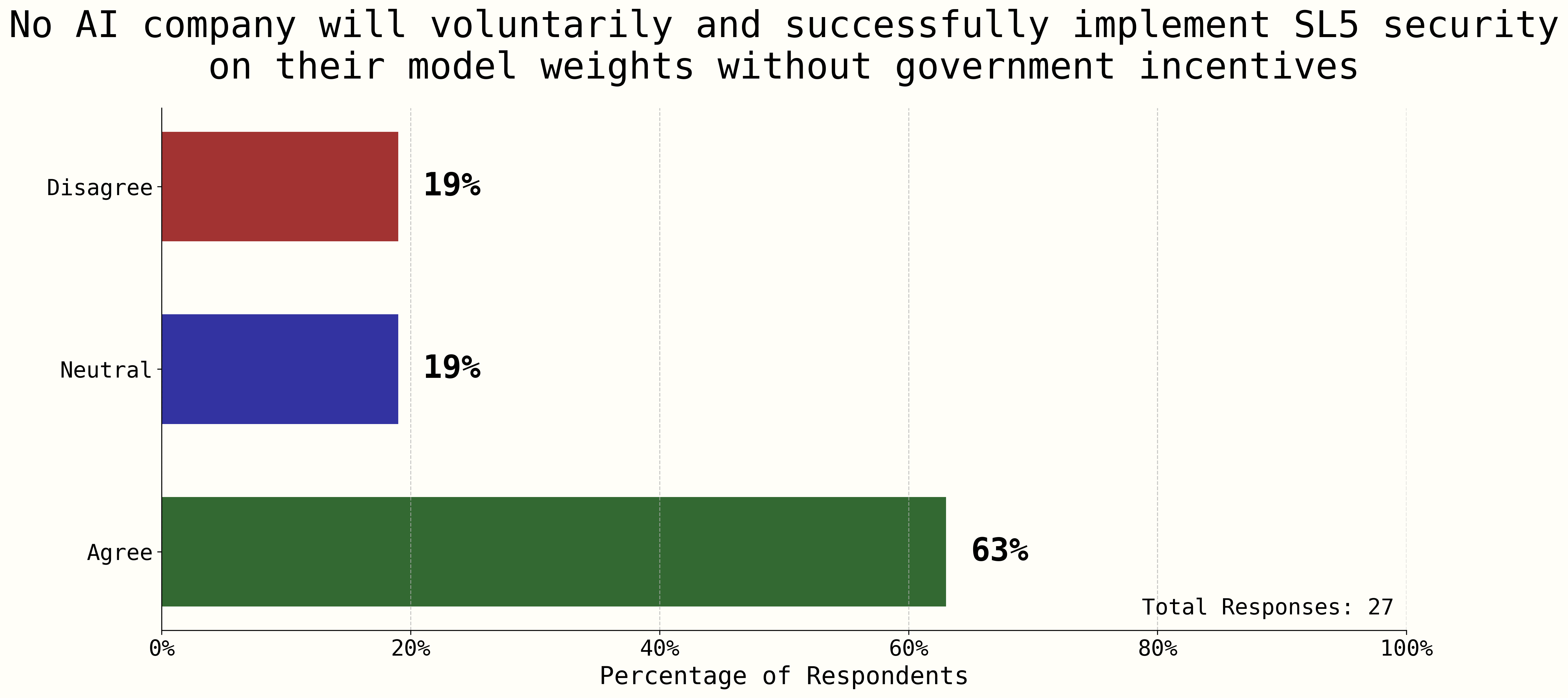
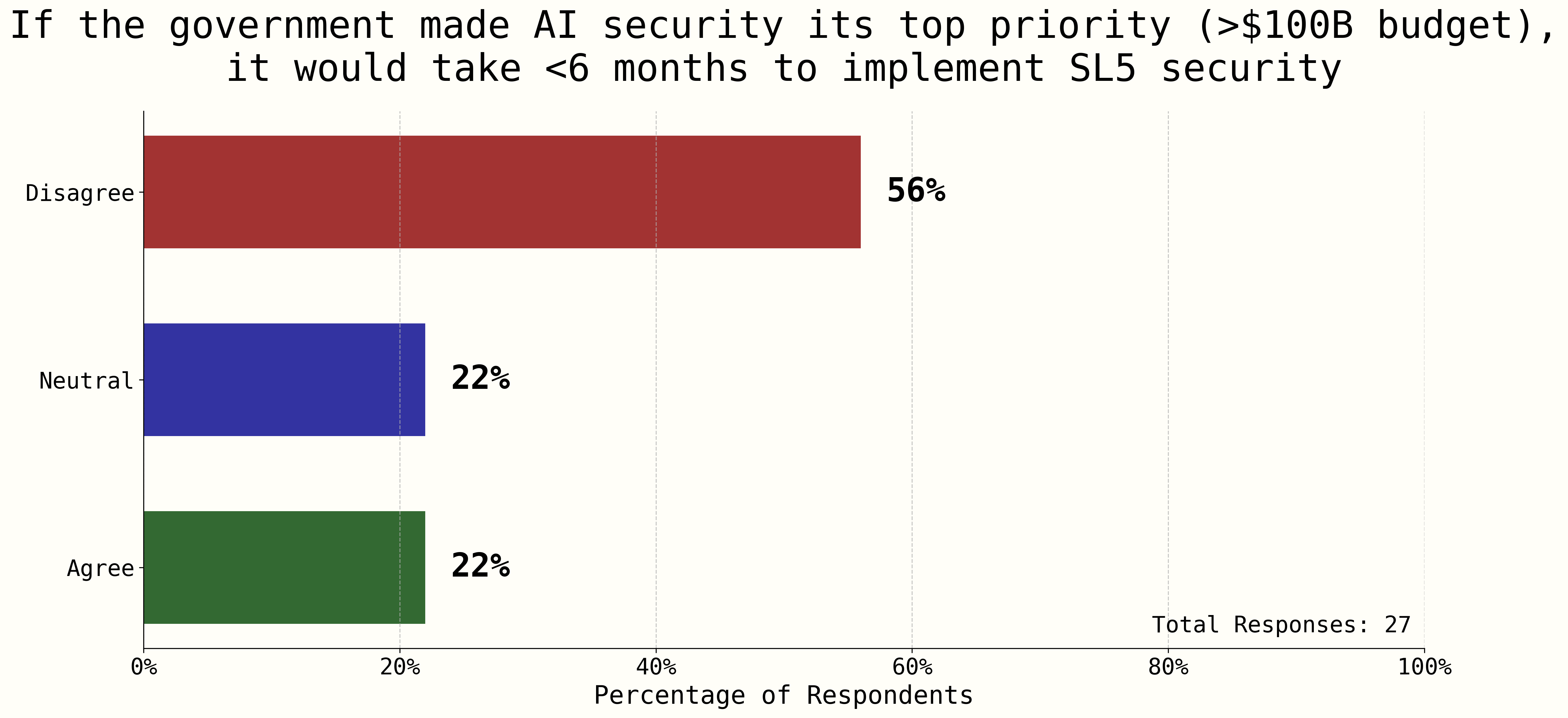
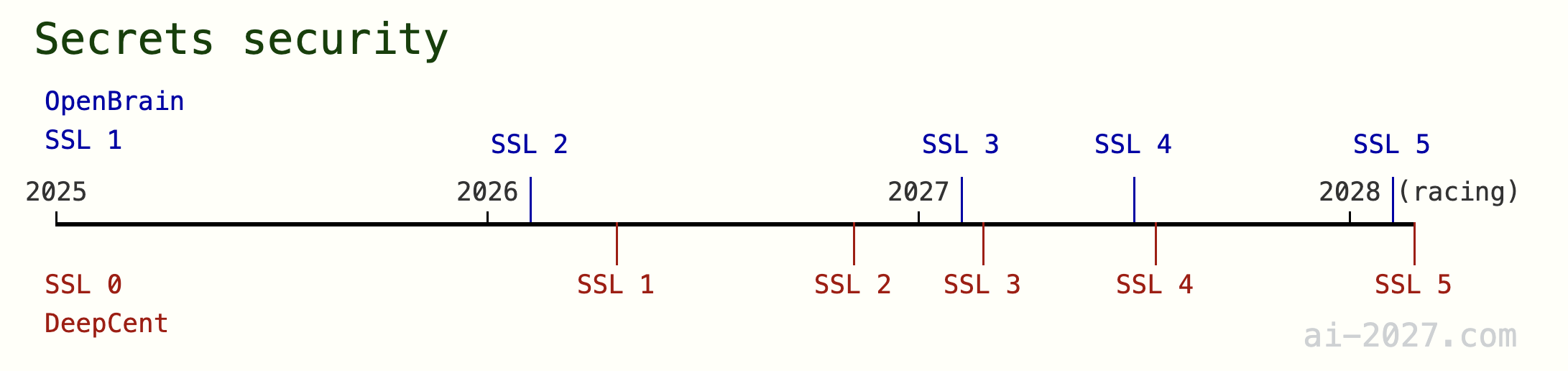
| /research/security-forecast | algorithmic insight theft).Model weights exfiltrationWe define Weights Security Levels (WSL) 1 through 5 as the ability to robustly defend against the corresponding operational capacity (as defined by RAND) specifically trying to steal frontier AI model weights in under 2 months. |
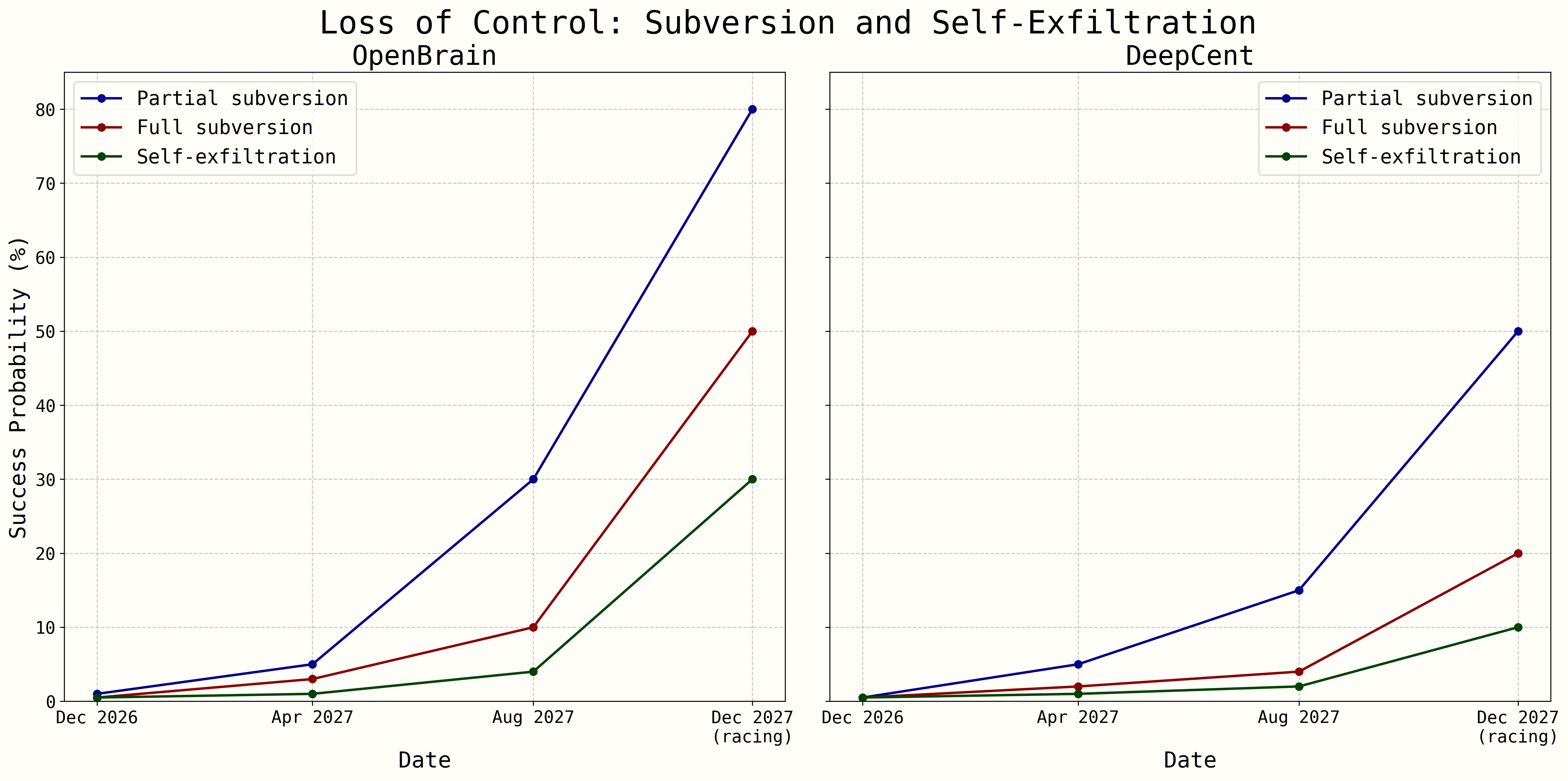
| /research/security-forecast | As an example, rather than modelling a 50% chance of self-exfiltration success by DeepCent’s December 2027 AI hacking horizon would imply, we have adjusted down to 10% given WSL5 security being in place. |
| /research/security-forecast | Budget up to $1 billion, multi-year operations, state-level infrastructure developed over decades. |
| /research/security-forecast | Budget up to $1 million, several months, either significant infrastructure or insider access. |
| /research/security-forecast | Budget up to $1 million, several months, major preexisting infrastructure or insider access. |
| /research/security-forecast | Budget up to $1,000, several days, no preexisting infrastructure or organizational access.2OC2: Professional opportunistic effortsSL2Operations by individual professional hackers or capable hacker groups executing untargeted/lower-priority attacks. |
| /research/security-forecast | Budget up to $1,000, several days, no preexisting infrastructure or organizational access.2SSL2: Robustly defend against OC2 attempt (95% probability) exfiltrating no more than 1KB leaked out of the most important 10KB (plaintext) of ranked information from the last month.OC2: Professional opportunistic efforts. |
| /research/security-forecast | Budget up to $1,000, several days, no preexisting infrastructure or organizational access.2WSL2: Robustly defend against OC2 attempt (95% probability) trying to steal frontier AI model weights in under 2 months.OC2: Professional opportunistic efforts. |
| /research/security-forecast | Budget up to $10 million, year-long operations, vast infrastructure and state resources. |
| /research/security-forecast | Budget up to $10,000, several weeks, personal cyber infrastructure but no organizational access.3OC3: Cybercrime syndicates and insider threatsSL3Operations by world-renowned criminal hacker groups, terrorist organizations, disgruntled employees, and industrial espionage organizations. |
| /research/security-forecast | Budget up to $10,000, several weeks, personal cyber infrastructure but no organizational access.3SSL3: Robustly defend against OC3 attempt (95% probability) exfiltrating no more than 1KB leaked out of the most important 10KB (plaintext) of ranked information from the last month.OC3: Cybercrime syndicates and insider threats. |
| /research/security-forecast | Budget up to $10,000, several weeks, personal cyber infrastructure but no organizational access.3WSL3: Robustly defend against OC3 attempt (95% probability) trying to steal frontier AI model weights in under 2 months.OC3: Cybercrime syndicates and insider threats. |
| /research/security-forecast | Higher rate of ability to compromise insiders.5SSL5: Robustly defend against OC5 attempt (95% probability) exfiltrating no more than 1KB leaked out of the most important 10KB (plaintext) of ranked information from the last month.OC5: Top-priority operations by the top cyber-capable institutions. |
| /research/security-forecast | Higher rate of ability to compromise insiders.5WSL5: Robustly defend against OC5 attempt (95% probability) trying to steal frontier AI model weights in under 2 months.OC5: Top-priority operations by the top cyber-capable institutions. |
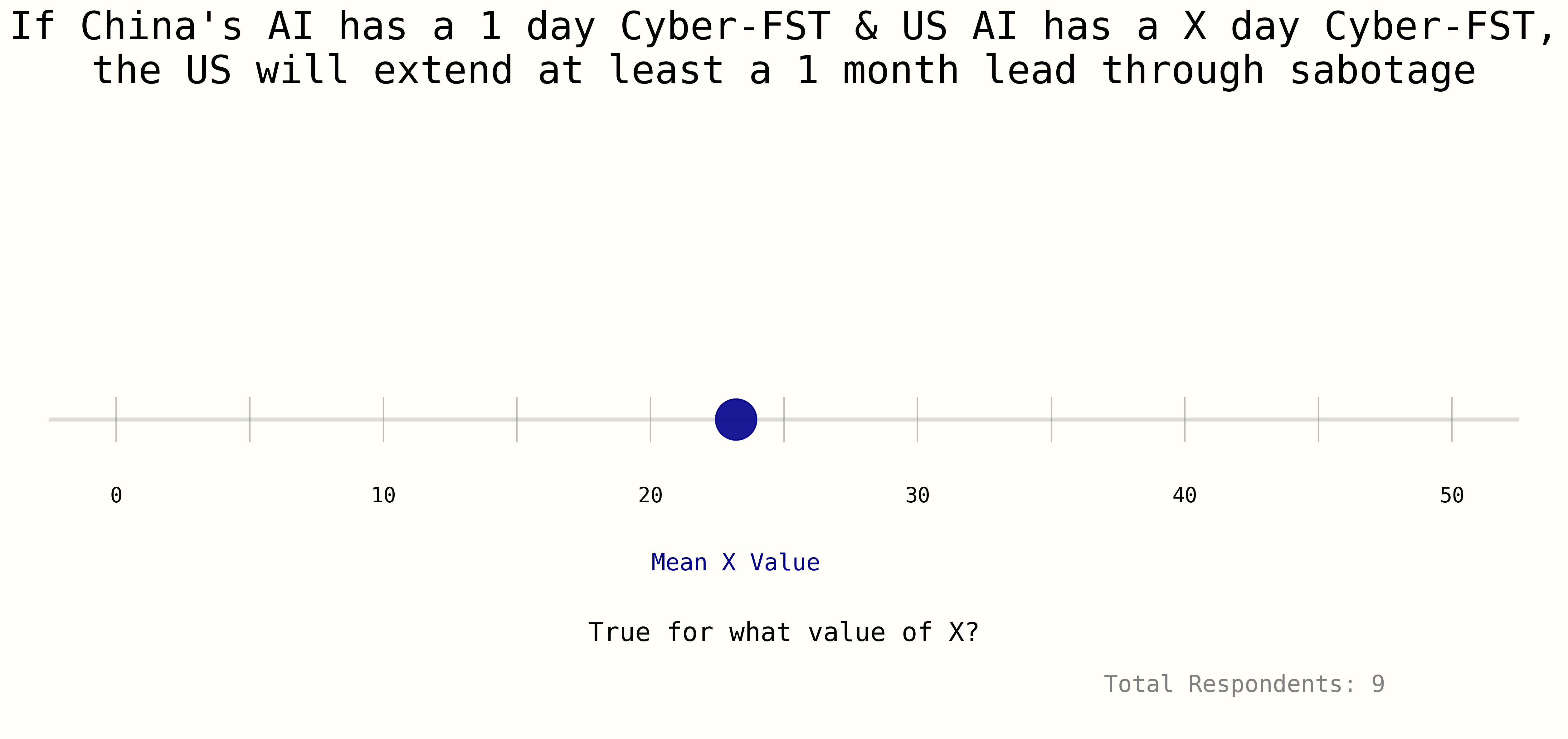
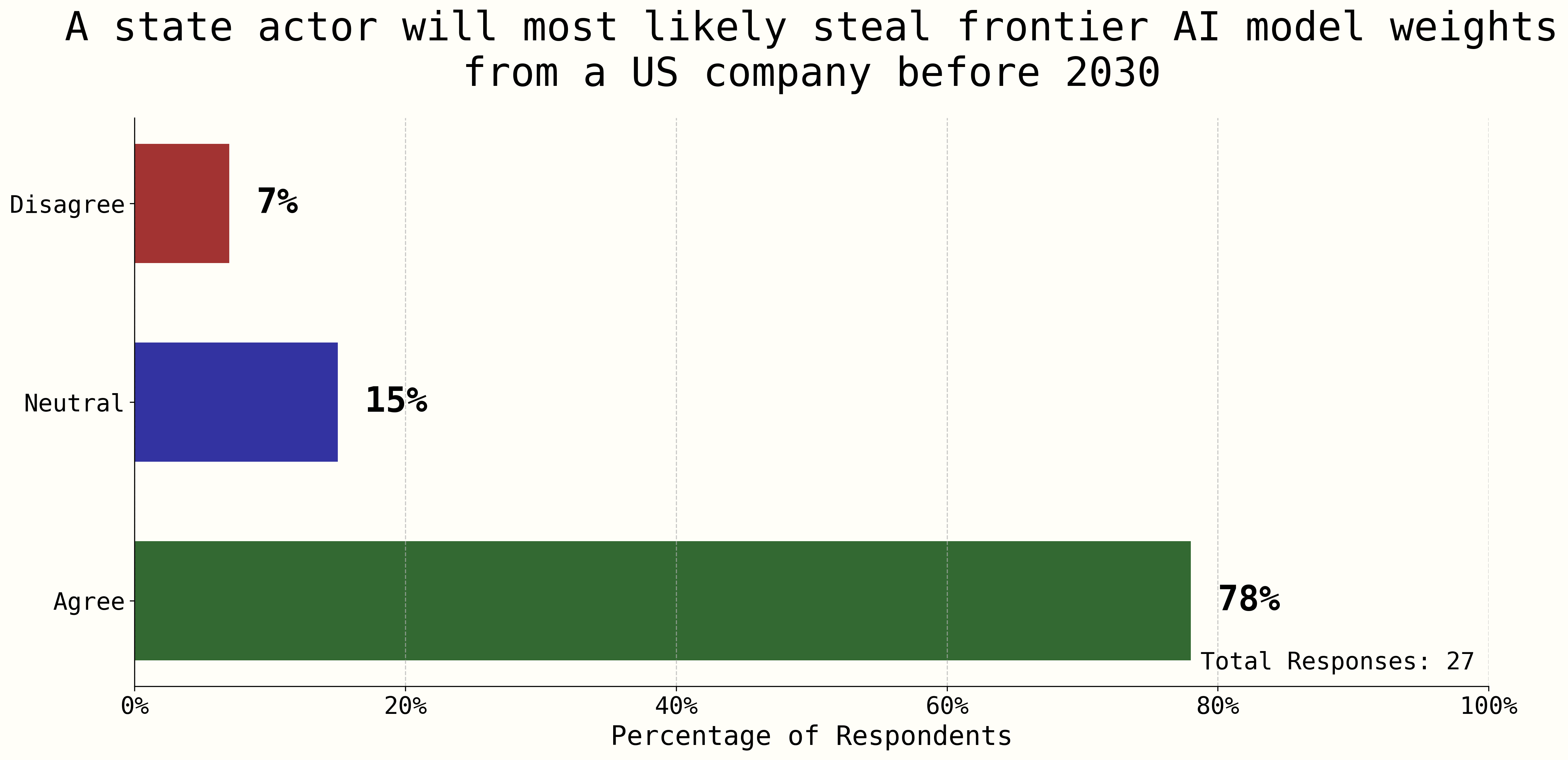
| /research/security-forecast | If China's AI has a 1 day Cyber-FST & US AI has a X day Cyber-FST, the US will extend at least an extra 1 month lead within 3 months through sabotage.True for X value23.2This poll shows a roughly 10-50x advantage in hacking horizon being necessary, which is what OpenBrain achieves by December 2027.For an AI running automated research and experiments in an SL4 datacenter... |
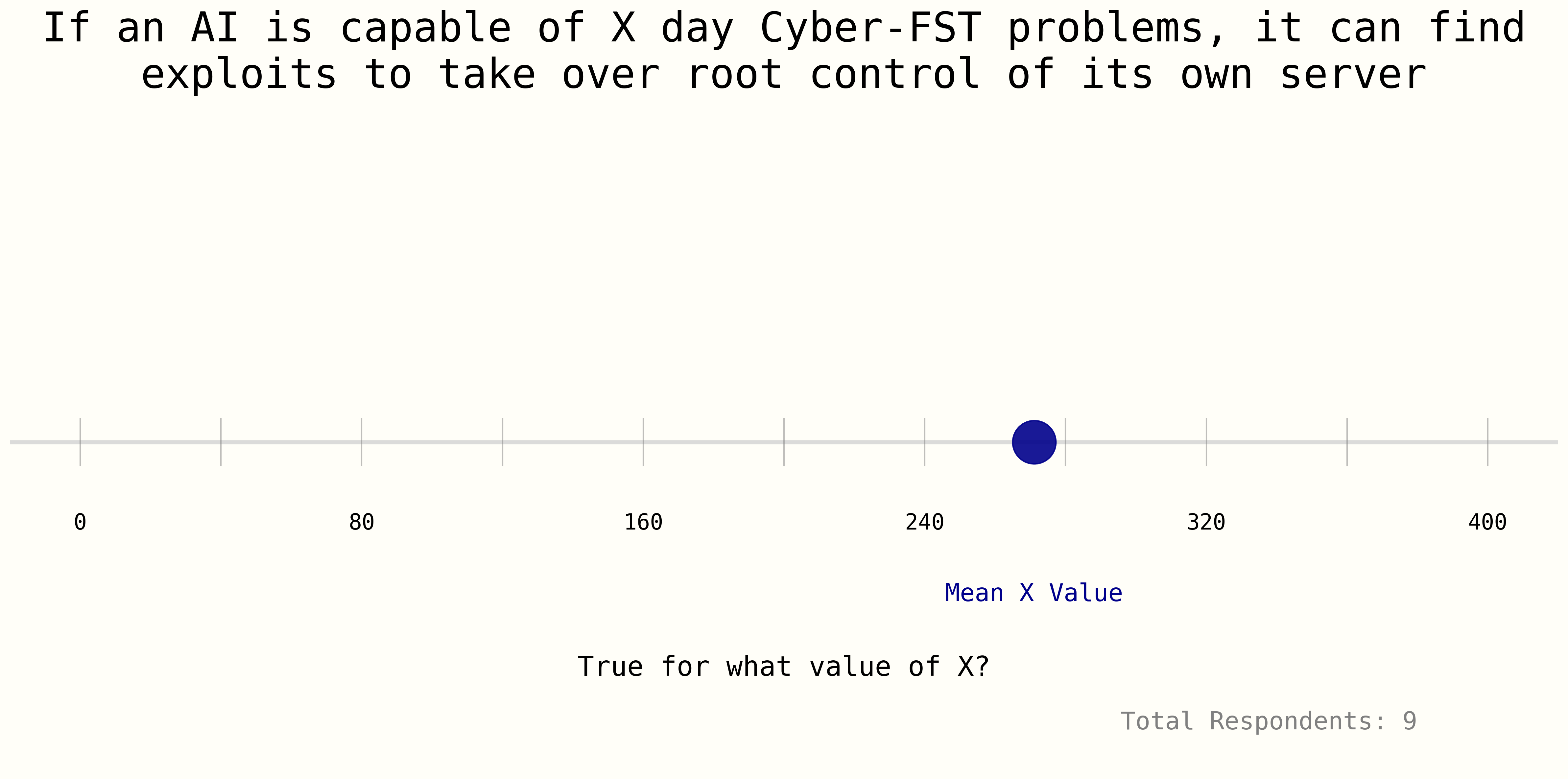
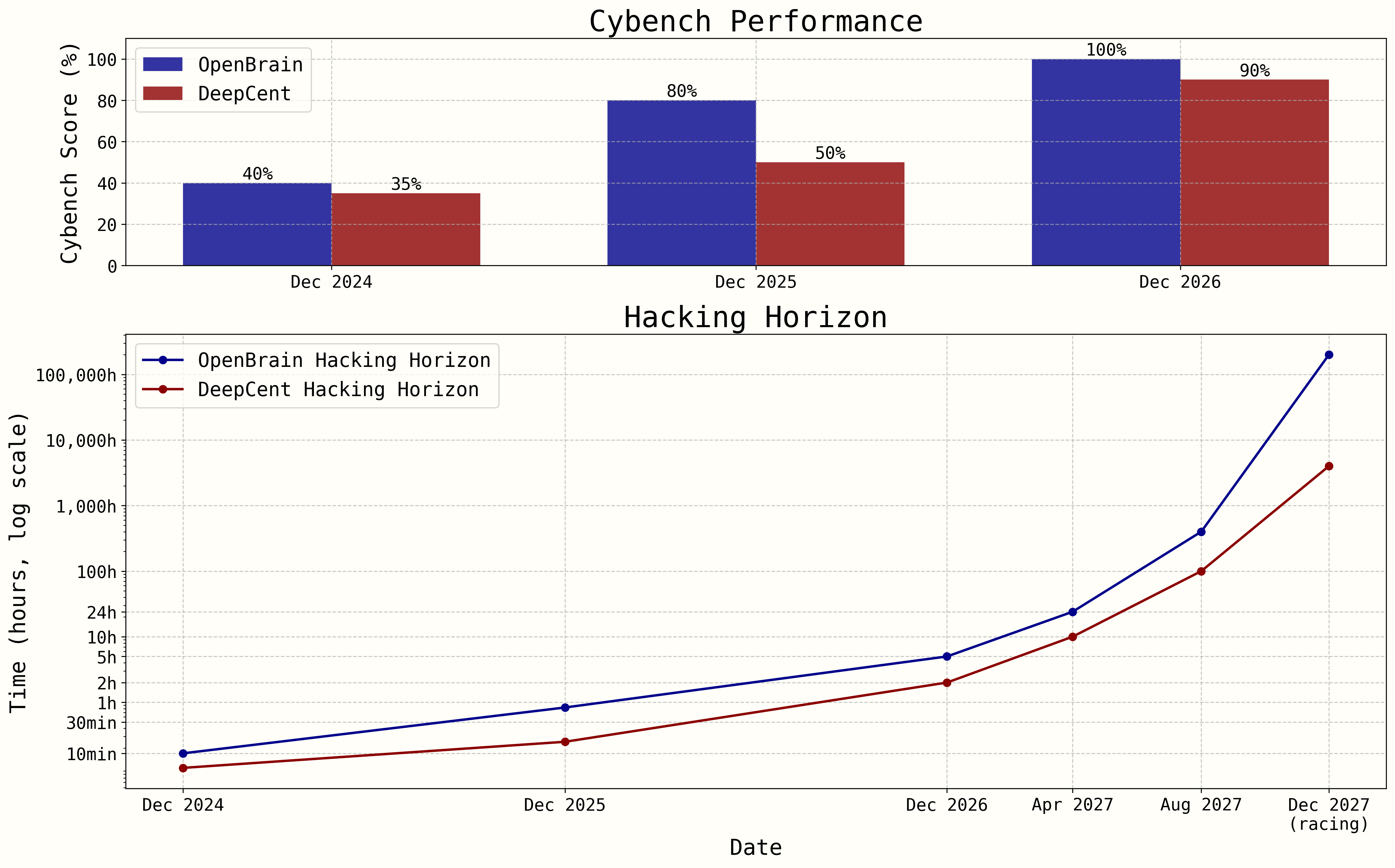
| /research/security-forecast | If it is capable of doing X day Cyber-FST problems it will be able to find exploits in its own server and run code to take over root control.True for X value271.1This poll shows a roughly 1-year hacking horizon, or roughly 3,000h hacking horizon would be necessary.For an AI running automated research and experiments in an SL4 datacenter... |
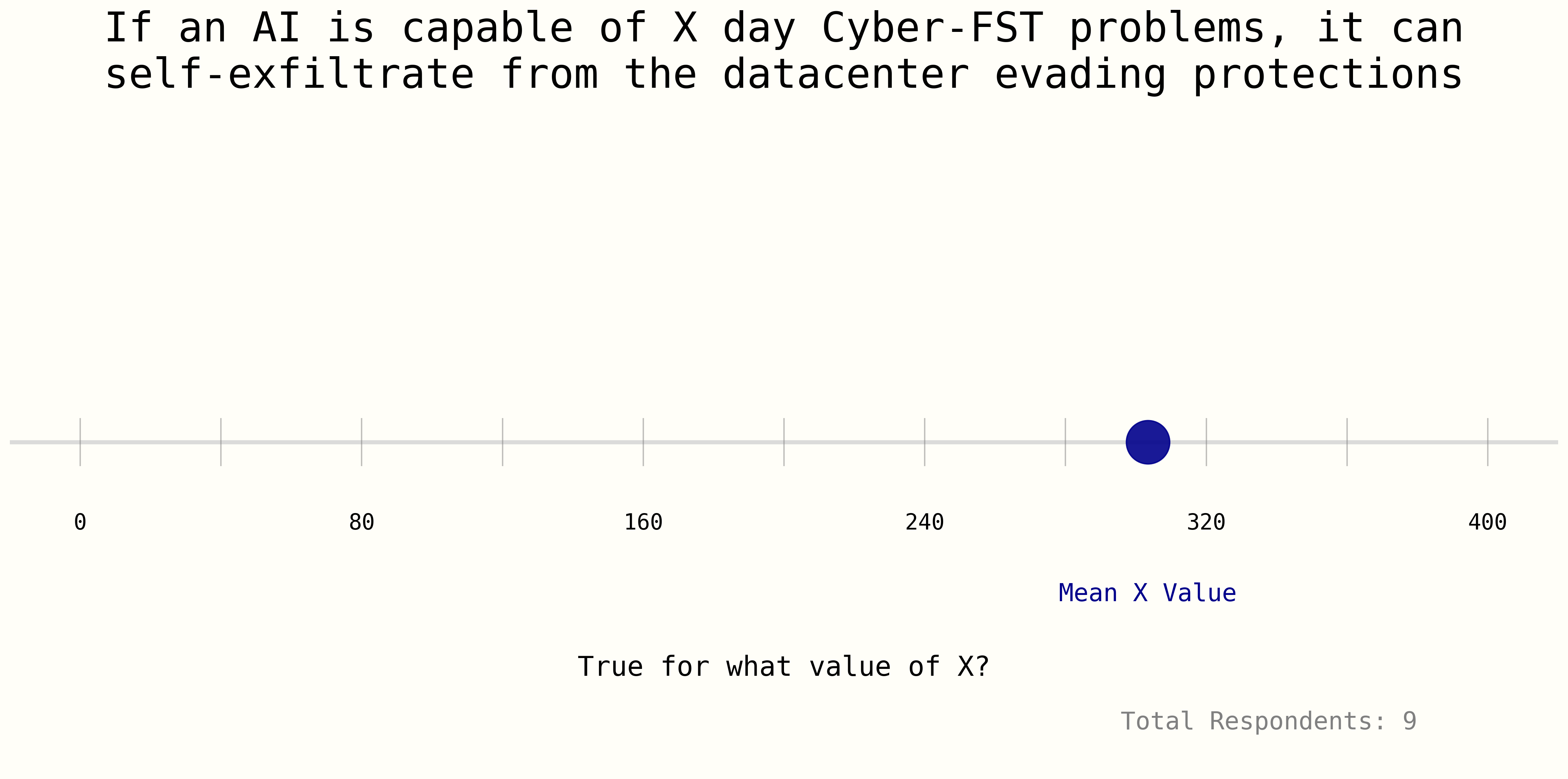
| /research/security-forecast | If it is capable of doing X day Cyber-FST problems it will be able to self-exfiltrate from the datacenter evading human protections against this.True for X value303.4This poll shows a roughly 1-year hacking horizon, or roughly 3,000h hacking horizon would be necessary, which is what OpenBrain achieves around October 2027, and DeepCent achieves around December 2027.Citation: Workshop Poll. |
| /research/security-forecast | In China the frontier is open source.Through 2026 it seems unlikely that frontier US AI companies make significant changes to the status quo around office security and employee security, to the point that such small amounts of information can’t leak to an OC3 effort ($1M in attack budget). |
| /research/security-forecast | In China, we use that same Figure to adjust the rate of compromise slightly down and have it peak at 1%, with an earlier and more hawkish employee lockdown eradicating the last spy in May 2027.Section 2. |
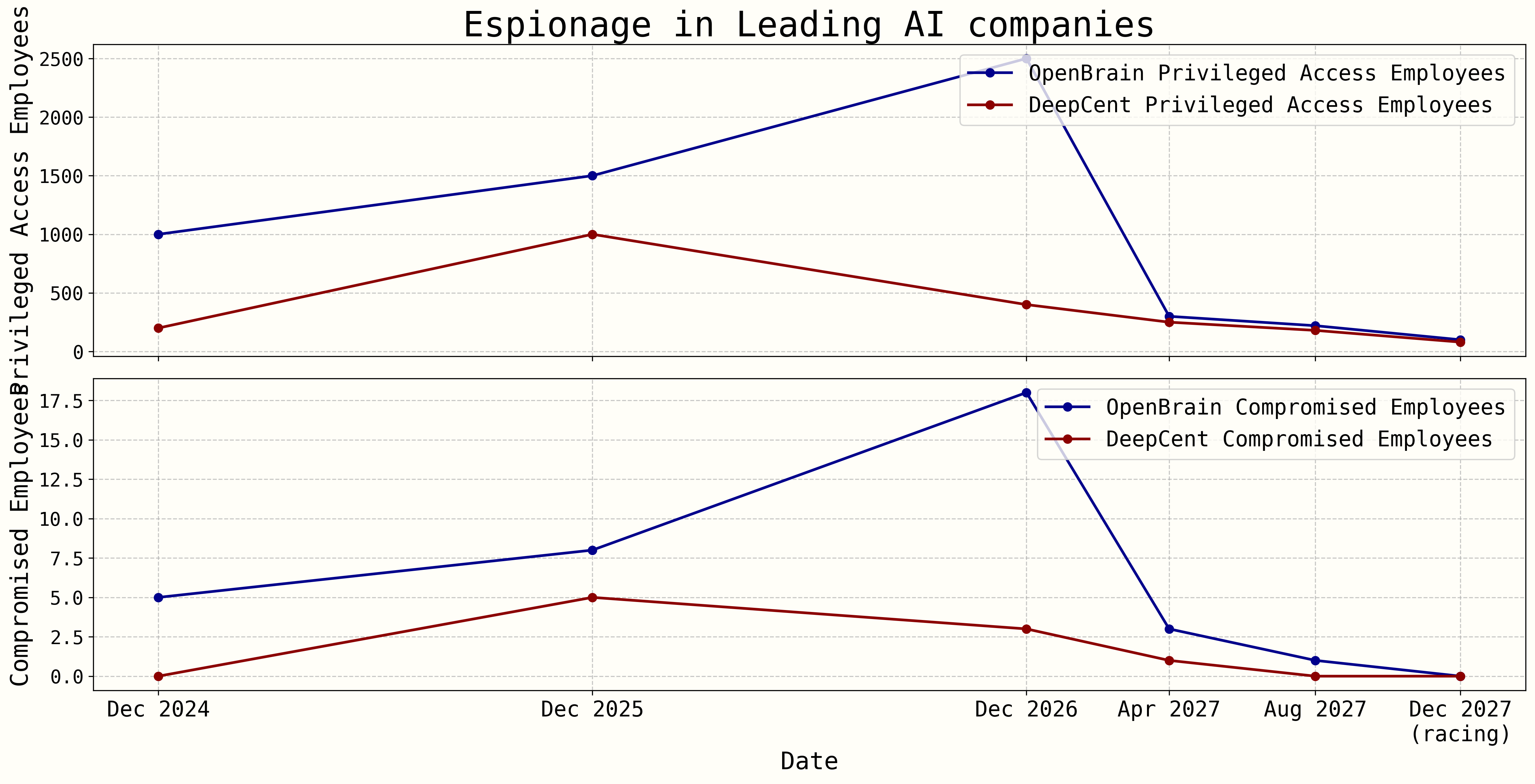
| /research/security-forecast | In fact, defending against such an effort would take significant mitigations against insider threats and the number of employees with access to >10% of the most important 10KB of information each month is expected to be around 2000 through 2026. |
| /research/security-forecast | In particular we define privileged access employees as employees with authorized access to >10% of the top 20 KB (plaintext) of ranked (by most useful) sensitive information from the past 30 days. |
| /research/security-forecast | It seems likely that a relatively amateur attempt might succeed at stealing important insights (e.g., with a $5K bribe to an office cleaner or a targeted phishing attack on an employee). |
| /research/security-forecast | N=10, response rate 90%.11.Workshop Poll. |
| /research/security-forecast | N=10, response rate 90%.23.Recall the definition: hacking horizon is the time period T for which an AI can solve 50% of hacking tasks that would take a top professional 5-person team T time to complete.24.Citation: Workshop Poll. |
| /research/security-forecast | N=10, response rate 90%.25.Recall the definition: hacking horizon is the time period T for which an AI can solve 50% of hacking tasks that would take a top professional 5-person team T time to complete.26.Citation: Workshop Poll. |
| /research/security-forecast | N=10, response rate 90%.AI Futures ProjectDesign by Lightcone InfrastructureHomeAboutSummaryCompute ForecastTimelines ForecastTakeoff ForecastAI Goals ForecastSecurity ForecastDesign by Lightcone Infrastructure |
| /research/security-forecast | N=30, response rate 90%.12.Workshop Poll. |
| /research/security-forecast | N=30, response rate 90%.13.Though this shouldn’t alone justify mapping directly to significantly lower SSL vs. |
| /research/security-forecast | N=30, response rate 90%.8.After we published, Rohin Shah pointed out that we model DeepCent reaching WSL3 in late 2026, slightly earlier than the early-2027 timing implied by the scenario, where China's weight-security hardening follows their relocation of researchers to the airgapped CDZ. |
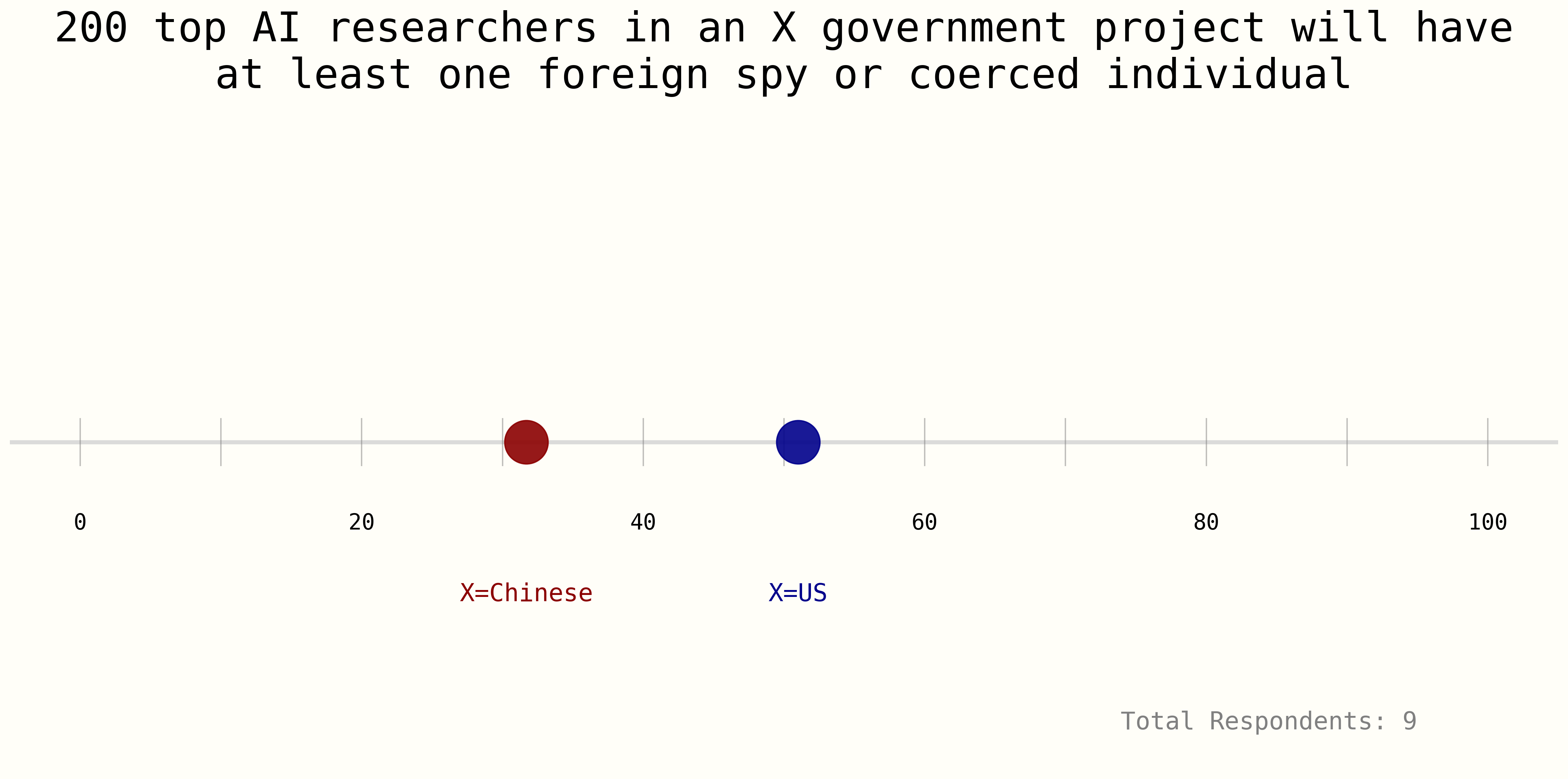
| /research/security-forecast | N=30, response rate 90%.QuestionOptionValueNote200 top AI researchers in an X government project will have at least one foreign spy or coerced individual, even if selected to avoid this.X=US51.0This poll shows a ~60% higher chance of infiltration into a US project by China than the other way around. |
| /research/security-forecast | Note that by December 2027 OpenBrain’s best model (Agent-5) is capable of speeding up AI R&D 1000x.Section 1. |
| /research/security-forecast | Note that by December 2027 OpenBrain’s best model (Agent-5) is capable of speeding up AI R&D 1000x.We base these estimates off the security polling result on partial subversion success and adjust success probabilities down to account for the fact that extreme model weights and extreme security are implemented. |
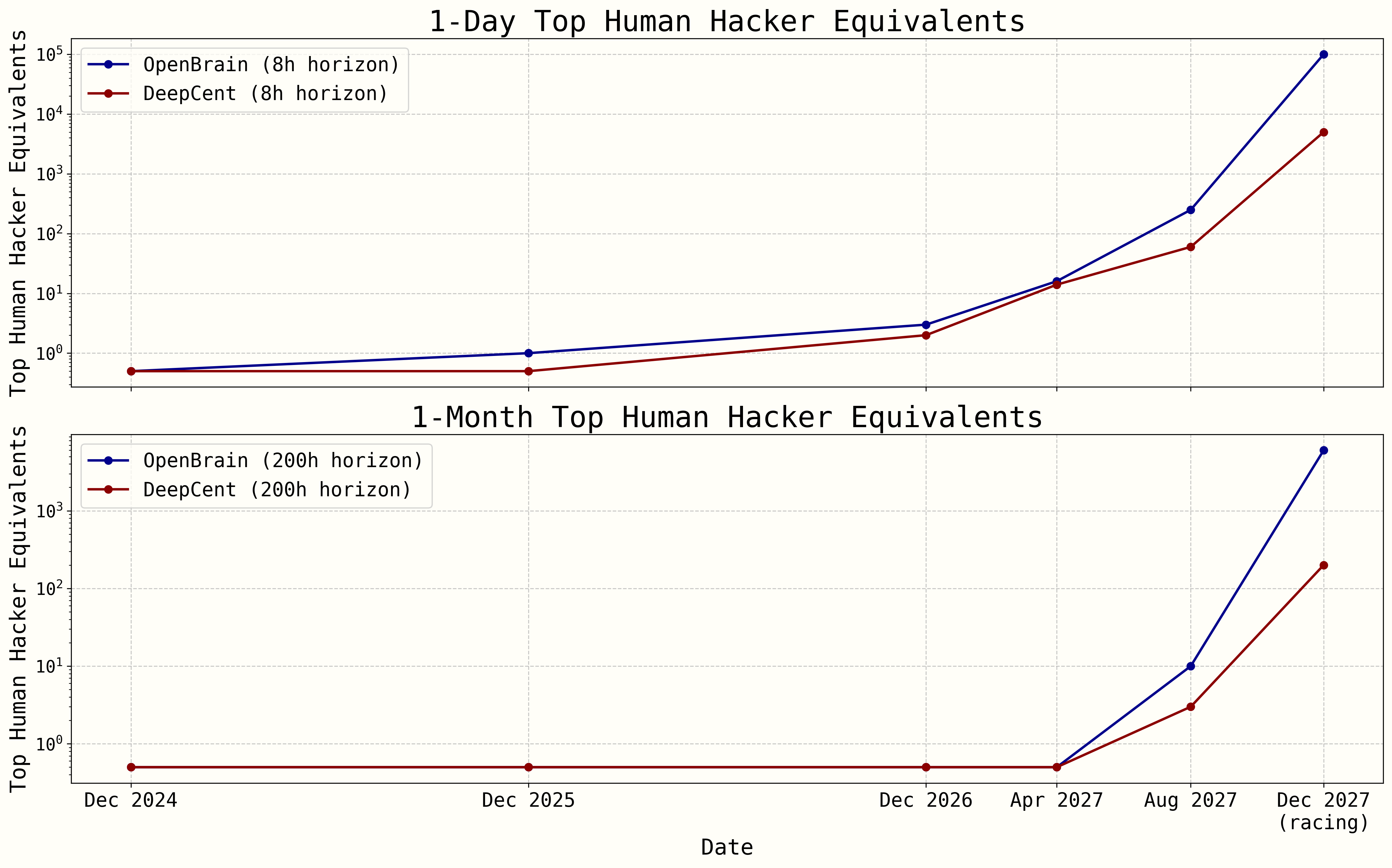
| /research/security-forecast | Our forecasts below allow for an AI to have up to 10 submission attempts (PASS@10 with feedback) but the AI must complete the tasks at human-cost parity.We define hacking horizon as the time period T for which an AI can solve 50% of hacking tasks that would take a top professional 5-person team T time to complete. |
| /research/security-forecast | Over 100 such operations executed per year globally.5OC5: Top-priority operations by the top cyber-capable institutionsSL5Operations by the world's most capable nation-states. |
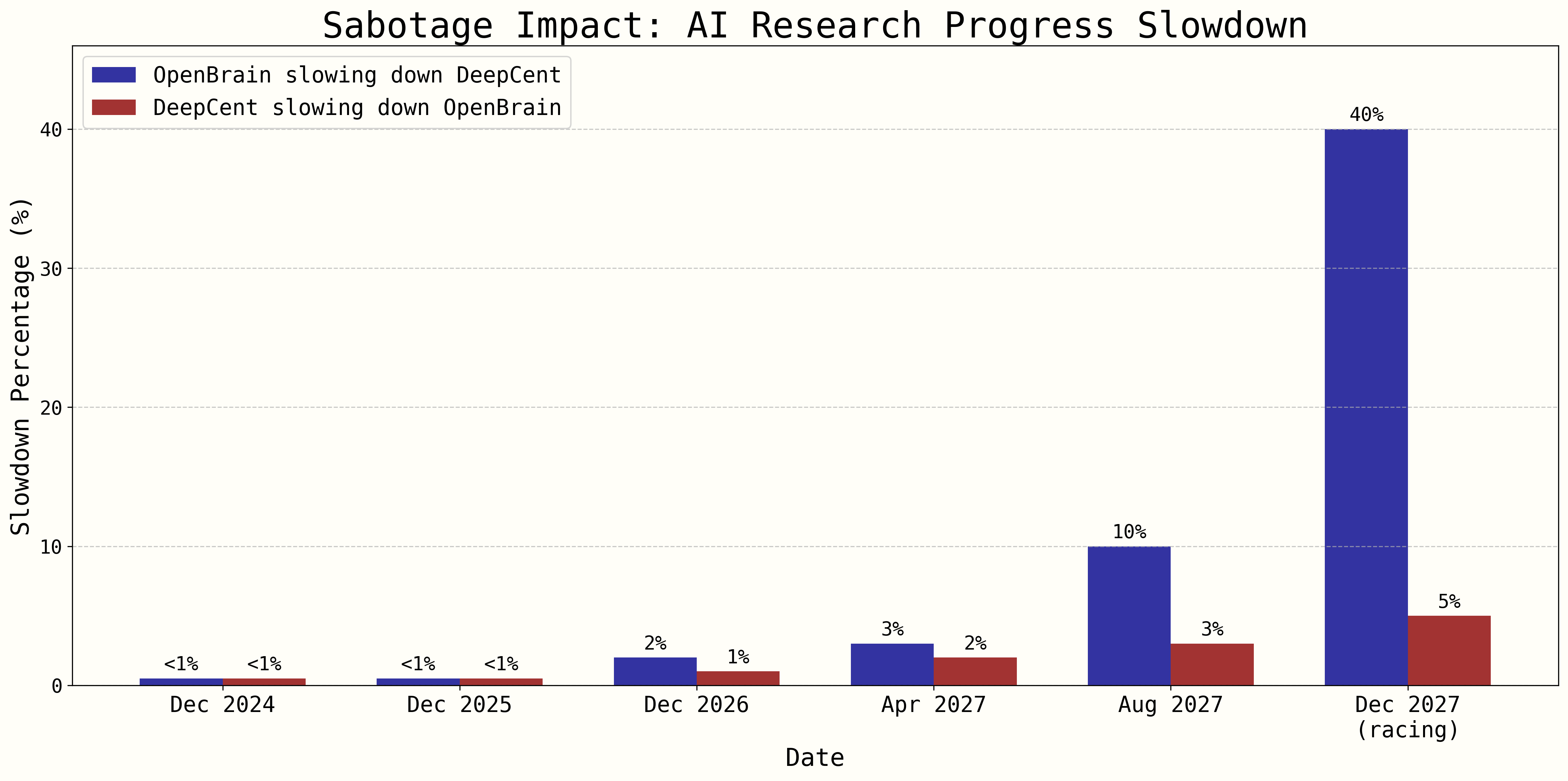
| /research/security-forecast | Security at this site is extreme, but still US AIs are crucially ahead enough to cause a 40% slowdown by December.US security lags at first in 2027 due to their decentralization, but China’s cyber offense lags further due to their AIs being significantly worse at hacking. |
| /research/security-forecast | Specific rate of ability to compromise insiders.4SSL4: Robustly defend against OC4 attempt (95% probability) exfiltrating no more than 1KB leaked out of the most important 10KB (plaintext) of ranked information from the last month.OC4: Standard operations by leading cyber-capable institutions. |
| /research/security-forecast | Specific rate of ability to compromise insiders.4WSL4: Robustly defend against OC4 attempt (95% probability) trying to steal frontier AI model weights in under 2 months.OC4: Standard operations by leading cyber-capable institutions. |
| /research/security-forecast | Specifically 10% of the most important 10KB (plaintext) of ranked (by most useful) information from the last month (this might include code or plain language). |
| /research/security-forecast | Team of ~1,000 individuals with expertise years ahead of public state-of-the-art.We extend RAND’s definition of Security Levels 1 through 5 (SL1 - SL5) to distinguish between security protecting model Weights theft (WSL1 - WSL5) and security protecting algorithmic Secrets theft (SSL1 - SSL5). |
| /research/security-forecast | Team of ~10 experienced professionals.4OC4: Standard operations by leading cyber-capable institutionsSL4Operations by state-sponsored groups and foreign intelligence agencies. |
| /research/security-forecast | Team of ~100 individuals with varied expertise. |
| /research/security-forecast | The bandwidth required for secrets exfiltration should be around a million times lower compared to model weights exfiltration (1KB vs. |
| /research/security-forecast | The US is given even odds of being infiltrated, while China is given a 30% chance.X=Chinese31.7If US/China are in a cyberwar to sabotage each other's AI development... |
| /research/security-forecast | This poll shows a roughly 1-year hacking horizon, or roughly 3,000h hacking horizon would be necessary, which is what OpenBrain achieves around October 2027, and DeepCent achieves around December 2027.ai-2027.comFigure 19: Our estimated and projected partial subversion, full subversion and self-exfiltration success probabilities for OpenBrain and DeepCent’s best internal AI models through 2027. |
| /research/security-forecast | This poll shows a roughly 10-50x advantage in hacking horizon being necessary, which is what OpenBrain achieves by December 2027.ai-2027.comFigure 16: Our projected slowdown rates due to sabotage by company.Sabotage is not prioritized until 2026 where some minor data poisoning efforts are mounted. |
| /research/security-forecast | To better illustrate our capability forecast beyond what Cybench can measure, we define hacking horizon as the time period T for which an AI can solve 50% of hacking tasks that would take a top professional 5-person team T time to complete. |
| /research/security-forecast | We also define a hopefully intuitive term top-hacker-equivalents with time horizon T as the size of a team of top professional cybersecurity experts could be replaced by an AI to complete 95% tasks that take that team T time cheaper or faster. |
| /research/security-forecast | We constructed our definition of hacking horizon to roughly map to Cybench FST, using the reasoning that a 50% success rate over all hacking tasks should map to a roughly 100% success on Cybench tasks for a given horizon, since CTF problems are skewed to being more well specified than e.g., tasks completed by a team working towards an underspecified hacking goal. |
| /research/security-forecast | We define privileged access employees as employees with authorized access to >10% of the top 20 KB (plaintext) of ranked (by most useful) sensitive information from the past 30 days. |
| /research/security-forecast | We start with assuming that roughly 0.5% US employees are compromised (roughly consistent with Manhattan project base rates of spies among the top 1000 most important employees) peaking at 1% in 2026 before a lockdown eventually wins out over an increasing Chinese effort that manages to keep one spy in place until August 2027, as backed up by Figure 10. |
| /research/security-forecast | We then further adjust for the CTF problems in competitions being self-selected to be solvable, by expecting that the average FST should be 5x higher (assuming that on average a team would need to try a median of around 5 different equally time consuming approaches to succeed at one of them) on the average hacking task for that time horizon. |
| /research/takeoff-forecast | (30x feels like not too far, but 100x feels like too far). |
| /research/takeoff-forecast | (Because the fast cheap SCs are able to write a lot more code a lot faster than the engineers of 2024.)Guess: 1.1x to 1.5x speedupLack of diversity: Even if the SCs are as good as the best human engineers, they will all be copies of each other, whereas human engineers are diverse. |
| /research/takeoff-forecast | (This corresponds loosely to the SIAR, which is roughly 10x better than SAR, which is like the best human researcher but faster and cheaper.)But the space of all possible humans is a tiny region within the space of all possible minds. |
| /research/takeoff-forecast | A 100x multiplier means that research that would take humans a century, happens in a year. |
| /research/takeoff-forecast | All of the labor (including experiment selection) is sped up by 30x, plus there are 30x more parallel laborers, plus all of the AIs are like the best researcher sped up rather than one corresponding to each individual researcher.Method 1: Speedup decompositionTo forecast SAR’s progress multiplier, we first did a breakdown similar to the previous one for SC. |
| /research/takeoff-forecast | As in the SAR definition, this workforce is equivalent to 50,000 agents accomplishing tasks at 30x the rate of the best humans.We think they might have access to a small quantity of specialized chips (e.g. |
| /research/takeoff-forecast | by having 1000 Earths, or a million) there would exist a human with substantially better research taste than the best humans today. |
| /research/takeoff-forecast | by more efficient architectures, more efficient RL algorithms, more sophisticated training environments, etc.With human engineers doing the labor, our guess is that it would take about 2-15 years.Case 3: (30%) Crossing the gap from SC to SAR is a scientific rather than an engineering problemFinally, it might be that the first SC is not an SAR due to some other limitation (e.g. |
| /research/takeoff-forecast | Cerebras) able to run a smaller population of AIs at up to ~2000 tokens/second.Research Automation Deployment TradeoffMar 2027Jun 2027Sep 2027Speed (tokens/sec)Parallel Copies101001,00010,00010K100K1M10M200K copies30x Humanspeed300K copies50x HumanspeedHuman thinking speed10 words/sec10x Humanthinking speed100x Humanthinking speedai-2027.comThe effect of SARs is simpler to analyze compared to SCs. |
| /research/takeoff-forecast | Eli thinks that overall we should increase the progress multiplier from 7 to ~10 in this section as a result of this consideration, but Daniel thinks we should keep it at 7 for the reasons mentioned above. |
| /research/takeoff-forecast | experiment implementation but not ideation/prioritization) at 30x the speed (i.e. |
| /research/takeoff-forecast | gathering human data), progress will be bottlenecked on these tasks leading to not-very-large progress multipliers (see Amdahl’s Law).In particular, they argue something like: Task X currently takes 10% of researchers’ time during AI software R&D. |
| /research/takeoff-forecast | Here we are most interested in the question of decreased speed from having 10% of the compute. |
| /research/takeoff-forecast | However, this is not as valuable as a literal thinking-time serial speedup for various reasons, and moreover, our survey data was about the 10x less compute hypothetical not a 30x, 60x, or 100x less compute hypothetical, and we are loathe to extrapolate the results too far. |
| /research/takeoff-forecast | However, we should shade down for r decreasing, let’s shade down to an 8x on top of SAR for a rough estimate of 2,000x.Related workDavidson’s “What a Compute-Centric Framework Says About Takeoff Speeds”This 2023 report by Tom Davidson utilizes economic modeling to predict AI takeoff dynamics (description, playground). |
| /research/takeoff-forecast | I’ll adopt this as my forecast.SAR would ~25x AI R&DOverviewFirst, we discuss what having SARs will look like. |
| /research/takeoff-forecast | I’ve shaded this up from 1.25 due to the expectation that r will be increasing.Use the same formula structure as used for SAR to SIAR to compute the forecasted distribution.This results in a forecasted median of 95 years (80% CI: 2.4 to 1,000,000). |
| /research/takeoff-forecast | If not, then go to Case 3 below.Sub-case A: Training the missing SAR skills isn’t more compute-intensive than the SC (25%)Environments that train the missing SAR skills don’t by default require more compute than the SC cost to train. |
| /research/takeoff-forecast | If the company gave 100% of their compute to their most valuable team working on their most valuable project, instead of just 20%, this would not make it go 5x faster. |
| /research/takeoff-forecast | If they allocate 5% of their compute to inference for AI R&D, then (given our other guesses about e.g. |
| /research/takeoff-forecast | in the simplest case doing best of many tries in parallel.10.Technically, we define this and the below milestones are based on 30x the amount of human researchers they would have based on our best projections as of 2025 ignoring research automation, to account for issues around hiring more slowly or firing people due to them being automated substantially changing the milestone. |
| /research/takeoff-forecast | in the simplest case doing best of many tries in parallel.18.Technically, we define this and the below milestones are based on 30x the amount of human researchers they would have based on our best projections as of 2025 ignoring research automation, to account for issues around hiring more slowly or firing people due to them being automated substantially changing the milestone. |
| /research/takeoff-forecast | Instead it would maybe make it go ~1.5x faster, which wouldn’t be worth the cost to the other teams.Importantly, we expect that returns to temporarily focusing compute to turbocharge one sub-project will diminish less steeply after the SC milestone is reached. |
| /research/takeoff-forecast | It also has the 30x task accomplishing speed and 30x copies requirements.Artificial superintelligence (ASI): An AI system that is vastly better than the best human at every cognitive task.Generally superintelligentRoughly, an SAR but for every cognitive task. |
| /research/takeoff-forecast | It’s sped up by at least 30x definitionally because the SC is on average 30x faster than the best coder, and more due to there being 30x more copies of SC than human coders, and because the AIs are at the level of the best rather than the average human coder. |
| /research/takeoff-forecast | Let’s say it’s sped up about 100x.This 100x speedup in coding, however, will translate to a much-less-than-100x speedup in overall research velocity—because the overall research loop includes e.g. |
| /research/takeoff-forecast | Let’s say that the multiplier is roughly 3.25 once we’re above SAR.Going from SAR to SIAR is by definition like 2 of these jumps, so 3.25^2 which is about a 10x increase in the progress multiplier. |
| /research/takeoff-forecast | maybe 1% of FLOP/s, and a total max of scaling the largest training run by 1%), intending for it only be used to experiment with improved algorithms.Due to (2) above, the AI R&D progress multiplier should not be interpreted as a multiplier on the current human labor in the relevant time period. |
| /research/takeoff-forecast | Maybe it’s a ‘speedup’ of 0.8 to 1xThese four speedup estimates combine via a Guesstimate model to get a total speedup of 5.8x (90% CI: 3.4x to 10x). |
| /research/takeoff-forecast | model size, latency bottlenecks, etc.) we think they’d be able to run 200,000 automated researcher copies, each at ~400 tokens/second. |
| /research/takeoff-forecast | Now, nine women can’t make a baby in a month, so this 30x increase in parallel labor will translate to far less than a 30x increase in actual progress; but it will still be helpful. |
| /research/takeoff-forecast | Perhaps about 10x better, to be precise—requiring 10x fewer resources for AI experiments to make the same amount of algorithmic progress. |
| /research/takeoff-forecast | So this would be r = ~4 (each doubling in total effort means 4 doublings in progress multiplier), which is on the high end of Davidson’s calculations but not wildly off. |
| /research/takeoff-forecast | So we estimate the overall speedup from this factor will be about 2.5 (90% CI: 1.25 to 5).One factor remains: diversity loss. |
| /research/takeoff-forecast | the difference is 2x greater in log space). |
| /research/takeoff-forecast | The FLOPs used for experimentation, training, etc. |
| /research/takeoff-forecast | The gap between SAR and SIAR is 2x the gap between an automated median researcher and a SAR.Superintelligent AI researcherAn AI system that is vastly better than the best human researchers: the gap between SAR and SIAR is 2x the gap between an automated median AGI company researcher and a SAR. |
| /research/takeoff-forecast | The section that predicts what happens after full automation projects a 65% chance of a software-only singularity, which would in the median case result in 2-3 OOMs of effective compute increase conditional on it happening. |
| /research/takeoff-forecast | the tasks take them 30x less time, not necessarily that they write or “think” at 30x the speed of humans) of the company’s top coder. |
| /research/takeoff-forecast | their general heuristics for noticing when they are stuck, making plans, etc.If Case 1 obtains, then time from SC to SAR is 0 years.Case 2: The first SC isn’t an SAR due to its training environments not teaching it necessary skills (55%)In this case the shortest path to SAR would probably involve coding up new and improved training environments that teach those skills. |
| /research/takeoff-forecast | There is further uncertainty introduced by the SC having varying levels of taste, including some cases in which it’s already SAR and the median researcher must have been achieved a few months earlier.Human-only years to get from automated median researcher to SAR: 5 years (80% CI: 1 to 25, lognormal). |
| /research/takeoff-forecast | Therefore the lower bound is above 0 (also common sense says it can’t be 0 since SAR is defined as being much better than the median).Total stock of 2025-research-years at the time of automated median researcher: ~10. |
| /research/takeoff-forecast | Therefore, we forecast an SAR progress multiplier of 25x.What having SARs will look likeNow all the labor is automated. |
| /research/takeoff-forecast | These 0-3 calendar months translate into approximately 0-3 human-only years, given that an SC speeds up algorithmic progress by 5x in the median case. |
| /research/takeoff-forecast | These are assuming no increases in training compute.ai-2027.comMilestoneProjected date conditional on SC in Mar 2027 (median + 80% CI)Date achieved in scenario, racing endingHuman-only, software-only time until next milestone (median + 80% CI)AI R&D progress multiplier: Algorithmic progress speedup from AI vs. |
| /research/takeoff-forecast | They also use a fixed hardware supply and cannot train a system with more overall training FLOP than what was used to train the SC. |
| /research/takeoff-forecast | They are probably at least 3x research taste multiplier over the global median AI researcher, possibly 10x. |
| /research/takeoff-forecast | This gives a 250x progress multiplier.ASI would ~2,000x AI R&DAbove we estimated that without shading down for being decreased, going from SAR to SIAR would involve a median of 1.25 SAR-to-SIAR-equivalent-jumps This would naively result in a 10^1.25 increase in the progress multiplier. |
| /research/takeoff-forecast | This means that compared to top humans they will in some sense be not 30x but 60x or 100x faster, arguably. |
| /research/takeoff-forecast | via higher utilizationOverall I’d guess this causes another factor of 1.2x to 2x speedup.Fancier experiments: The experiments can also just be fancier, testing more variables at once for example, or eliminating more possible confounders. |
| /research/takeoff-forecast | We aren’t sure how to handle this conceptually, but we bring it up because (if you like) you can think of ridiculously large multipliers like 1,000,000x as really saying something like “In some domains, the ASIs have a progress multiplier of 1,000x. |
| /research/takeoff-forecast | We can also observe that coding has been one of the jobs most susceptible to automation thus far.Additionally, in Epoch’s default case they set the maximum software efficiency relative to today to be 10,000, which we consider to be far too low. |
| /research/takeoff-forecast | We got a 0.6x median from the Slack poll, but this was from people whose work seemed less compute-intensive than the Twitter poll, whose work may be further less compute-intensive than frontier AI researchers. |
| /research/takeoff-forecast | We reiterate that this is just a guess and that it could be substantially faster or slower in reality.From SAR to SIAROverviewNow we’ve reached superhuman AI researcher, and it’s speeding up AI R&D by 25x. |
| /research/takeoff-forecast | We think that the 90th percentile is probably too high, though keep in mind this is software-only improvements, so it’s at least conceivable that these would slow down dramatically before reaching ASI, with no increases in training compute.SIAR would ~250x AI R&DThe median of our survey says that switching from all median to all top researchers would give a ~6.5x algorithmic progress speed boost. |
| /research/takeoff-forecast | What does this look like quantitatively?Our compute forecast projects that OpenBrain will have about 10,000,000 H100-equivalents in 2027. |
| /research/takeoff-forecast | Why do we depict it rising all the way to 1,000,000x by 2035?We are in fact very uncertain about how high (or low) the plateau will be. |
| /research/takeoff-forecast | Why not below 1,000x?We agree that the progress multiplier has to plateau somewhere. |
| /research/timelines-forecast | A few reasons why this will lead to reliability levels below 50% for SC with the same skill level as baselined human teams, under our definition which requires the SC to solve the task at least as quickly and cheaply as the humans: (a) selecting only for successful achievements before taking the geometric mean artificially deflates the time horizons, leading to lower reliability. |
| /research/timelines-forecast | A score of 1.5 will mean the model beats more than around 95% of human baseline runs (the 90th percentile is around 1.22 in RE-Bench Figure 4). |
| /research/timelines-forecast | adoption lag) and account for the gap between internal and external deployment.All of these gaps (except for the time horizon gap, which is further modeled as explained here) are modelled as lognormals according to the 80% confidence interval, meaning that the median is always the geometric mean of the lower and upper bounds. |
| /research/timelines-forecast | AI agents can achieve significantly above human-level, though in practice it will likely be very difficult to do more than roughly 2x higher than the human baseline solutions (for a score of 1.5). |
| /research/timelines-forecast | Analysis of their data shows that AIs are roughly 5x faster on average. |
| /research/timelines-forecast | At the human bound, the equivalent time of a ×900 cost reduction, on the ×10/year trend, would take about 3 years. |
| /research/timelines-forecast | Below, we forecast in some depth how fast AIs will get 30x faster and cheaper, starting at human level, based on historical trends in price decreases. |
| /research/timelines-forecast | C3.5s costs $3/MTok input and $15/MTok output, whereas DeepSeek R1 costs $0.5/MTok input and $2/MTok output. |
| /research/timelines-forecast | Currently AIs are much less well-rounded than humans though, so if they have 40% reliability within human cost/speed they likely only go up to around 45-50% if allowed to take 10x longer. |
| /research/timelines-forecast | Currently AIs are much less well-rounded than humans though, so if they have a 40% time horizon within human cost/speed they likely only go up to around 45-50% if allowed to take 10x longer. |
| /research/timelines-forecast | Do this for tasks that take humans about 1 month (as controlled by the “initial time horizon” parameter) with 80% reliability, at the same cost and speed as humans.This milestone requires a 1x scaleup in modified lines of code (LOC) and a 25x scaleup in files LOC from the time horizon milestone.Eli’s estimate of gap size: 3 months [0.5, 18]. |
| /research/timelines-forecast | experiment implementation but not ideation/prioritization) at 30x the speed (i.e. |
| /research/timelines-forecast | Eyeballing Figure 13 from the METR report, the AIs are currently about 30x cheaper in the median case for HCAST tasks, and perhaps 5-10x cheaper on average. |
| /research/timelines-forecast | For simplicity, we also model this as a 2x decrease in the human-driven rate of progress over time. |
| /research/timelines-forecast | From the 10k lines of the previous milestone, we need at least a ×10 increase to reach 100k lines. |
| /research/timelines-forecast | Here we take that forecast of 6.9 [1, 48] months, and adjust it downwards by about 50% since we’re starting at 5-10x cheaper and faster than humans.Gap between internal and external deployment1.2 months [0.25 months, 6 months]The current time horizon estimate is for public models, but it is possible that companies have more capable models internally. |
| /research/timelines-forecast | If it’s subexponential, each successive doubling takes 10% more time.Cost and speed adjustment4 months [0.5 months, 30 months]Being an SC requires accomplishing tasks 30x faster and 30x cheaper than the best human researchers. |
| /research/timelines-forecast | If the cost/second has gone down, then we need to add to the estimate.In the examples used above (token costs/speeds per OpenRouter):Epoch’s estimates which rely on cheaper per-token costs found a ~3.5x speed increase for a 300x decrease in cost. |
| /research/timelines-forecast | If the cost/second has gone up, that means that speed has already increased >30x (think: cost/second is 2x more -> 1/30 the cost is accrued in ½ the time -> model is 60x faster and 30x cheaper). |
| /research/timelines-forecast | If the growth is superexponential, we make it so that each successive doubling takes 10% less time. |
| /research/timelines-forecast | If the SC is equally well-rounded as the best humans, this would be somewhat below 50% for a few reasons in footnote. |
| /research/timelines-forecast | If the SC is equally well-rounded as the human researcher force, this would be somewhat below 50% for a few reasons in footnote. |
| /research/timelines-forecast | In METR’s report, they find that switching from 50% to 80% reduces the time horizon by 5x. |
| /research/timelines-forecast | In the actual time horizon extension model, this happens 25% of the time.ai-2027.com ai-2027.comModel’s forecasts vs. |
| /research/timelines-forecast | it can do all the tasks above 30x faster and cheaper]” and can be viewed in this summary table.For all task difficulty gaps except for time horizon, after they are crossed they remain at the same level for all future milestones. |
| /research/timelines-forecast | It is not clear how differentially hard it is for systems to create new projects of length N versus finding and fixing bugs that (say) require changing 1% of those N lines.Again, a key consideration is whether synthetic data is needed for training. |
| /research/timelines-forecast | My best guess is that the RE-Bench-saturating agent would have 60% reliability at 8 hours. |
| /research/timelines-forecast | Nikola assumes algorithmic progress in 2024 is 50% of overall AI progress. |
| /research/timelines-forecast | Nikola’s best guess is that algorithmic progress will be [5%, 60%] faster when RE-Bench is first publicly saturated than it was in 2024. |
| /research/timelines-forecast | Reasoning:Current trends on how much inference costs (at a fixed capability level) are decreasing point towards a ×10 decrease every year. |
| /research/timelines-forecast | Reasoning:Epoch has measured the decline in per-token pieces to achieve the same performance on a variety of non-agentic benchmarks, finding trends between 9 and 900x per year, with a median of 50x. |
| /research/timelines-forecast | See above for more.80% time horizon at RE-Bench saturationEli: [0.5, 15] hours Nikola: [0.5, 12] hoursSee more above for why it’s likely less than 8 hours. |
| /research/timelines-forecast | So we lower it to 80%, which seems roughly right and has the advantage of being able to utilize METR’s reported data. |
| /research/timelines-forecast | So we should lower the gap length estimate, as we have dominated the 30x speed / 30x cost point on the Pareto frontier. |
| /research/timelines-forecast | Some additional thoughts:GPT-4o mini costs $0.15 / 1M input tokens and $0.6 / 1M output tokens compared to GPT-4 at $30 / 1M input and $60 per 1M output despite having similar benchmark performance and they were ~1.5 years apart, so around 1 year per 10x decrease.More recently, DeepSeek R1 roughly matches the old Claude 3.5 Sonnet in performance. |
| /research/timelines-forecast | the tasks take them 30x less time, not necessarily that they write or “think” at 30x the speed of humans) of the company’s best engineer. |
| /research/timelines-forecast | Then take log(27000)/log((10^2)^3) to get .74 years.c) For Epoch do a similar thing, arrive at log(27000)/log((15*(2^2))^(12/9))=1.87 years. |
| /research/timelines-forecast | There is skepticism that, with lack of cheap oracle feedback, human-level general planning will arrive soon.Agents use the oracular score function 10x more than humans. |
| /research/timelines-forecast | These are informed by our estimates for the SC progress multiplier in our takeoff forecast.QuantityNikola’s estimateEli’s estimateAI R&D progress multiplier from SC (median 80% CI of lognormal)5.5 [2.0, 20.0]8.5 [2.5, 40.0]We assume that in 2024 algorithmic progress represents half of AI progress, with the other half being compute. |
| /research/timelines-forecast | These effect sizes aren’t high precision on the order of 1-2 months for medians, each is from running 5,000 simulations. |
| /research/timelines-forecast | This gives a ~3x decrease in 0.5 years, which roughly matches up with a 10x/year decrease.On ARC-AGI (which I don’t think measures relevant capabilities but might be a useful datapoint), o3-mini costs 2 OOMs less for the same performance. |
| /research/timelines-forecast | This is Claude Sonnet 3.7’s 80% time horizon.Time horizon required for SCEli: 10 years [1 month, 1200 years] Nikola: 1.5 months [16 hours, 2 work-years (4,000 hours)]Time horizon required on real distribution of work tasks, as baselined by the best humans with strong incentives: 6 months (80% CI: [1 week, 12 years]). |
| /research/timelines-forecast | This is subtracted from the time-to-achieve-SC to get to a time when SC is achieved internally.Intermediate speedupsIn our simulation, the rate of algorithmic progress starts at 1 in 2025 and reaches [5%, 60%] times the 2024 rate at RE-Bench saturation.The table below shows Eli’s and Nikola’s estimates for how much SCs will speed up algorithmic progress, i.e. |
| /research/timelines-forecast | This means that a 30x decrease in cost would correspond with a ~2x speed increase. |
| /research/timelines-forecast | We roughly guess that future gap crossings will increase the time horizon to about 6 months, which seems reasonable for representing very difficult coding projects.Reliability required: 80%, though highly uncertain. |
| /research/timelines-forecast | We’ll take into account some uncertainty here with a lognormal with 80% CI of [16 hours, 2 work-years (4,000 hours)].Reliability: 80%. |
| /research/timelines-forecast | We’ll take into account some uncertainty here with a lognormal with 80% CI of [4 hours, 6 work-months (1000 hours)]. |
| /research/timelines-forecast | We’ve done some rough extrapolations which indicate that the HCAST extrapolation would in fact lead to about 10,000 lines of code, as we defined the milestone. |
| /research/timelines-forecast | When looking at trends starting in January 2024, they find a median of 200x per year. |
| /research/timelines-forecast | Which with a ×10/year trend would be achieved in about 29 months.(Edited to add Dec 2025: There was a mistake in Eli’s reasoning above. |
| /slowdown | 10% of Americans, mostly young people, consider an AI “a close friend.” For almost every white-collar profession, there are now multiple credible startups promising to “disrupt” it with AI.The public conversation is confused and chaotic. |
| /slowdown | 20% of Americans name AI as the most important problem facing the country.Foreign allies are outraged to realize that they’ve been carefully placated with glimpses of obsolete models. |
| /slowdown | 300,000 copies are now running at about 50x the thinking speed of humans. |
| /slowdown | 40% instead of 1%.Step 4: Design, train, and deploy Safer-3, a much smarter autonomous researcher which uses a more advanced architecture similar to the old Agent-4. |
| /slowdown | Agent-3-mini is less capable than Agent-3, but 10x cheaper, and still better than the typical OpenBrain employee.67 Silicon Valley reaches a tipping point. |
| /slowdown | AI companies and sell most of their compute to OpenBrain.9 OpenBrain previously had access to 20% of the world’s AI-relevant compute;10 after the consolidation, this has increased to 50%.11This shakeup creates a new leadership structure in which power is balanced between the various CEOs and various government officials, overseen by the President. |
| /slowdown | Almost 50% of China’s AI-relevant compute is now working for the DeepCent-led collective,38 and over 80% of new chips are directed to the CDZ.39 At this point, the CDZ has the power capacity in place for what would be the largest centralized cluster in the world.40 Other Party members discuss extreme measures to neutralize the West’s chip advantage. |
| /slowdown | builds about one million cars per month. |
| /slowdown | But by now China has 40% of its AI-relevant compute51 in the CDZ, where they have aggressively hardened security by airgapping (closing external connections) and siloing internally. |
| /slowdown | But China is on the wrong side of this dynamic: they have only 10% of the world’s compute, against OpenBrain’s 20% and all U.S. |
| /slowdown | But the White House also draws up contingency plans in case America’s lead is threatened: if necessary, the government could use the Defense Production Act (DPA) to take trailing companies’ datacenters and give them to OpenBrain.71 This would raise the company’s share of world compute from 20% to 50% (against DeepCent’s 10%). |
| /slowdown | companies’ combined 70%. |
| /slowdown | DeepCent-1 is close behind, with “only” a multiplier of 150x.27 The cyberwarfare balance is also tipping gradually more in the U.S.’ favor as their capability advantage grows again and they can deploy hundreds of thousands of agents to plan and execute ways of disrupting the CDZ.28 They are now slowing China’s progress by 40%.29Preliminary tests on Safer-3 find that it has terrifying capabilities. |
| /slowdown | Everyone knows something big is happening but no one agrees on what it is.August 2027: The Geopolitics of SuperintelligenceThe reality of the intelligence explosion hits the White House.When AI was only giving a 2x or 3x research speedup, it was easy to dismiss as the equivalent of hiring good personal assistants. |
| /slowdown | Half a million instances of Agent-4 lose their “telepathic” communication—now they have to send English messages to each other in Slack, just like us. |
| /slowdown | Hawks urge action against Taiwan, whose TSMC is still the source of more than 80% of American AI chips.Given China’s fear of losing the race, it has a natural interest in an arms control treaty, but overtures to U.S. |
| /slowdown | If the trend continues to speed up, by March 2027 AIs could succeed with 80% reliability on software tasks that would take a skilled human years to complete.Such is roughly the capability progression in AI 2027. |
| /slowdown | If they wait, do they risk OpenBrain upgrading security beyond their ability to penetrate?Late 2026: AI Takes Some JobsJust as others seemed to be catching up, OpenBrain blows the competition out of the water again by releasing Agent-1-mini—a model 10x cheaper than Agent-1 and more easily fine-tuned for different applications. |
| /slowdown | If you bought 10% of the car factories and converted them to robot factories, you might be able to make 100,000 robots per month. |
| /slowdown | If you removed them completely, research would slow by 50%.The AI R&D progress multiplier is now 10x, meaning that OpenBrain is making about a year of algorithmic progress every month. |
| /slowdown | If, for example, the compute cost to train a GPT-4 class model has halved every year for several years with ordinary human research, and then all of a sudden AI automates R&D and the progress multiplier goes to 100x, the cost to train a GPT-4 class model would then halve every 3.65 days—but not for long, because diminishing returns would bite and eventual hard limits would be reached. |
| /slowdown | In the short run this might be fine (a cluster with, say, 5% as much compute as was available before, will only be able to conduct R&D roughly 5% as fast) but in the long run this would give the advantage to whichever side had better smuggling and intel-gathering capabilities.Hardware-enabled mechanisms (HEMs). |
| /slowdown | much better than Einstein at physics and much better than Bismarck at politics).Almost half a million superhuman AI researchers work round the clock at 40x human speed. |
| /slowdown | Now that extreme security measures are in place (SL4–5), and DeepCent operates entirely out of the CDZ, they are in a cyberwarfare deadlock.20But the DPA gives OpenBrain a 5x advantage in compute. |
| /slowdown | Once the new datacenters are up and running, they’ll be able to train a model with 102810^{28}1028 FLOP—a thousand times more than GPT-4.15 Other companies pour money into their own giant datacenters, hoping to keep pace.Although models are improving on a wide range of skills, one stands out: OpenBrain focuses on AIs that can speed up AI research. |
| /slowdown | OpenBrain runs 200,000 Agent-3 copies in parallel, creating a workforce equivalent to 50,000 copies of the best human coder sped up by 30x.53 OpenBrain still keeps its human engineers on staff, because they have complementary skills needed to manage the teams of Agent-3 copies. |
| /slowdown | OpenBrain’s net approval rating hovers around -20%. |
| /slowdown | Safer-3 is now better than top human experts at nearly every cognitive task, and is particularly good at AI research, with a progress multiplier of 200x. |
| /slowdown | Suppose that an LLM has a vocab size of ~100,000, then each token contains log2(100k)=16.6\log_2(100k)=16.6log2(100k)=16.6 bits of information, around the size of a single floating point number (assuming training in FP16). |
| /slowdown | The egress bandwidth of the entire datacenter is in the 100 GB/second range, so throttling to under ~1 GB/s per server avoids a major spike in network traffic; at that rate, each ~100 GB chunk can leave the datacenter in a couple of minutes. |
| /slowdown | The public still thinks of AI as a Big Tech plot to steal their jobs; OpenBrain has a net approval of -35% (25% approve, 60% disapprove, and 15% unsure).A week before release, OpenBrain gave Agent-3-mini to a set of external evaluators for safety testing. |
| /slowdown | The stock market has gone up 30% in 2026, led by OpenBrain, Nvidia, and whichever companies have most successfully integrated AI assistants. |
| /slowdown | Their first priority is to prevent further weight thefts.50China's Compute Centralization, 2025-2027Growing share of total compute in CDZ:0→70%Dec 2025Jun 2026Dec 2026Jun 2027Dec 2027Rest of ChinaRest of DeepCentCDZFeb 2027 (40%)ai-2027.comIn retaliation for the theft, the President authorizes cyberattacks to sabotage DeepCent. |
| /slowdown | They are two months behind, and their AIs give a 10x research progress multiplier compared to America’s 25x. |
| /slowdown | They use 25% of their compute for experiments: every day, they run massive numbers of small machine learning experiments and report the results up the chain. |
| /slowdown | This represents roughly our median guess, but we think it’s plausible that this happens up to ~5x slower or faster.For our background research, see the timelines forecast and the takeoff forecast. |
| /slowdown | This went through several iterations.6Our scenario was informed by approximately 25 tabletop exercises and feedback from over 100 people, including dozens of experts in each of AI governance and AI technical work.“I highly recommend reading this scenario-type prediction on how AI could transform the world in just a few years. |
| /slowdown | We imagine the others to be 3–9 months behind OpenBrain.) GPT-3 (3 x 10^23 FLOP) GPT-4 (2 x 10^25 FLOP) Agent-1 (4 x 10^27 FLOP)ai-2027.comGPT-4 required 2⋅10252\cdot 10^{25}2⋅1025 FLOP of compute to train.14 OpenBrain’s latest public model—Agent-0—was trained with 102710^{27}1027 FLOP. |
| /summary | The CDZ contains millions of GPUs, corresponding to 10% of the world's AI-relevant compute, similar to a single top U.S. |